
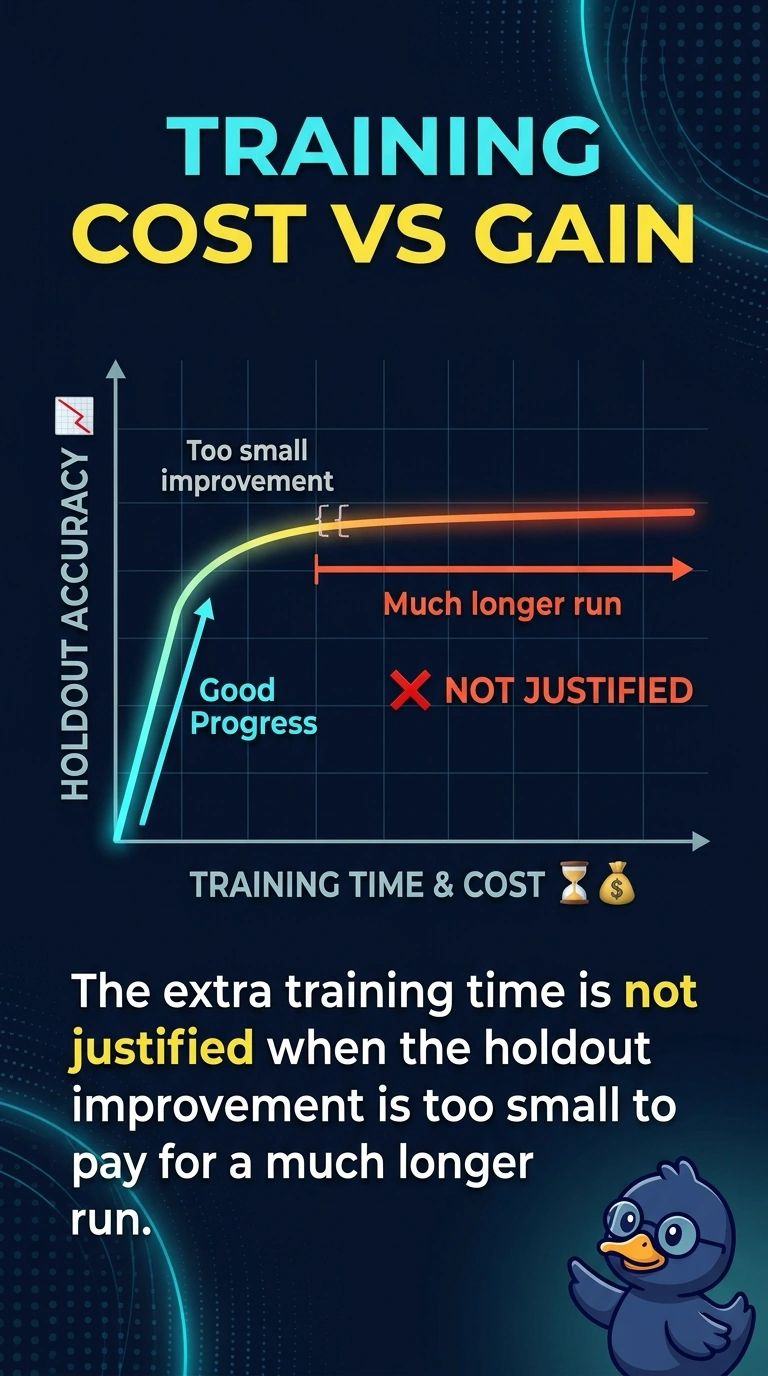
A hospital staffing model already meets the error target on the holdout set. A deeper model would take much longer to train and improves that holdout result only by a tiny amount. Which conclusion follows?
Select an answer to reveal the explanation.
Short Explanation
Once the staffing model already clears the bar, a tiny extra inch is a poor trade for a much longer climb. You should not spend the extra training time when the holdout lift is that small. Judging the gain on the training set is the trap, because that set flatters a longer run.
Full Explanation
When the current model already meets the holdout error target, extra training time has to earn its keep with a meaningful holdout improvement. A tiny lift does not pay for a much longer run, so the extra time is not justified and the deeper model should not be adopted on that basis. Replacing the current model because any improvement is worth the time ignores how small the lift is and how large the time cost is. Training until the holdout result never changes again sets an open-ended standard the requirement does not demand. Judging the tiny gain on the training set is worse, because a longer, deeper fit can look better on rows it has already seen without improving the holdout decision. Exam caveat: a tiny lift can still be required when the current model misses a hard safety target, which is not the situation described here. Operational check: put the holdout scores side by side, confirm the current model already meets the target, and stop when the deeper model's gain is only a tiny movement.