
A factory bottling line wants each sensor feature recentered at zero and rescaled so that a value of one means one standard deviation above that sensor's own mean. Which transform is that?
Select an answer to reveal the explanation.
Short Explanation
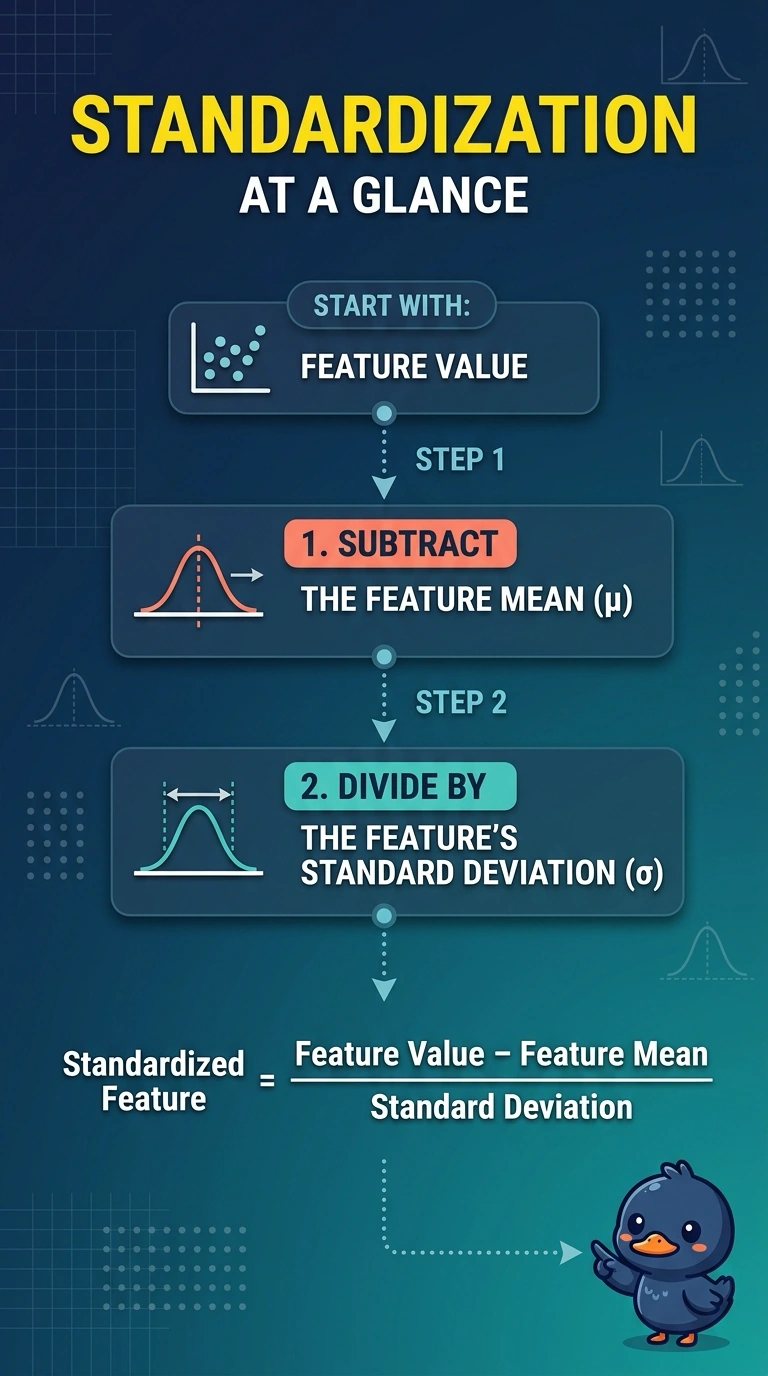
Standardization is like measuring every sensor in units of its own typical wobble, after you slide the average back to zero. You subtract the mean and divide by the standard deviation. The trap is a fixed-range stretch, or a log squash, which answers a different request.
Full Explanation
Standardization, often called a z-score, recenters a feature by subtracting its mean and rescales it by dividing by its standard deviation. After that transform, zero is the sensor's average reading and one is one standard deviation above that average, which is the scale the bottling line requested. The transform is applied feature by feature, so each sensor is measured in its own units of typical spread. Min-max scaling uses the minimum and the maximum to map readings onto a fixed range such as zero to one, and it does not divide by the standard deviation. A logarithm compresses large readings and can be useful for a skewed sensor, but it does not subtract the mean and divide by the standard deviation. Equal-width binning replaces the numeric reading with a bucket label, so the original scale, the mean, and the standard deviation are no longer the units of the feature. Exam caveat: the mean and standard deviation should be computed on the training rows and then applied unchanged to later rows, or the scale leaks information from the evaluation data. Operational check: after the transform, confirm a sensor's training values have mean near zero and standard deviation near one.