
A hospital laboratory wants each numeric assay mapped onto the fixed range from zero to one, using that assay's minimum and maximum in the training extract. Which scaling does that?
Select an answer to reveal the explanation.
Short Explanation
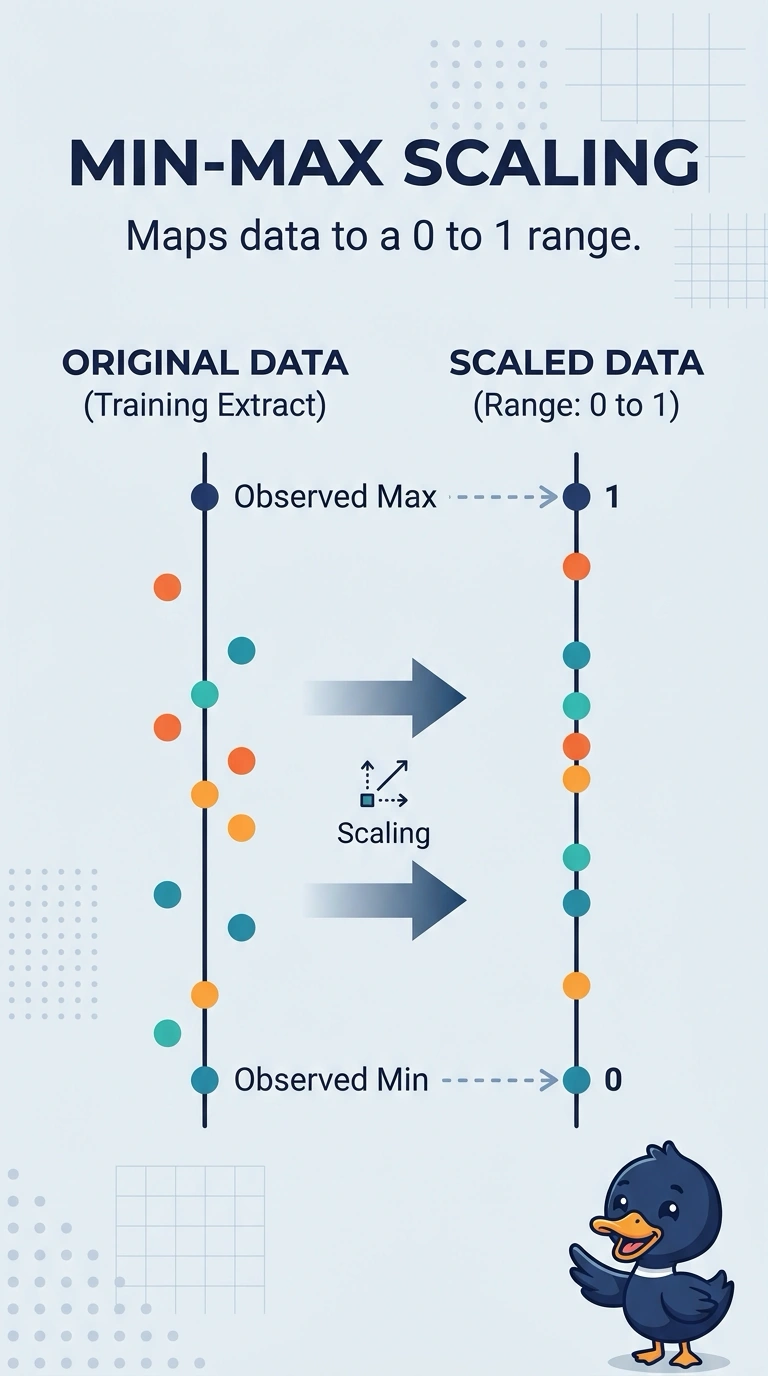
Min-max scaling pins a feature to a fixed track, from its lowest observed value to its highest. That is how you map an assay onto zero through one. Subtracting the mean and dividing by the spread does not pin those ends.
Full Explanation
Min-max scaling maps a feature onto a fixed range by using its minimum and maximum. Subtract the minimum, divide by the range between maximum and minimum, and the training minimum lands at zero while the training maximum lands at one. That is the transform the laboratory described. Standardization subtracts the mean and divides by the standard deviation. The result is centered and scaled by spread, but the smallest and largest assays are not pinned to zero and one. A rank transform replaces each value with an order position. Order is not the raw minimum and maximum used as endpoints, so a rank is a different feature even if someone later rescales ranks. Tail capping limits extremes and leaves the other values on the original measurement scale, so the assay is not mapped onto zero to one. Exam caveat: minimum and maximum should be taken from the training extract and reused on later extracts, and a new value outside that range will fall outside zero to one. Operational check: after scaling, confirm the training minimum of an assay is zero and the training maximum is one.