
A telecom fiber team balances a rare-outage table by synthesizing extra outage rows from patterns already present in the sample. The class counts now match. Which limitation still holds?
Select an answer to reveal the explanation.
Short Explanation
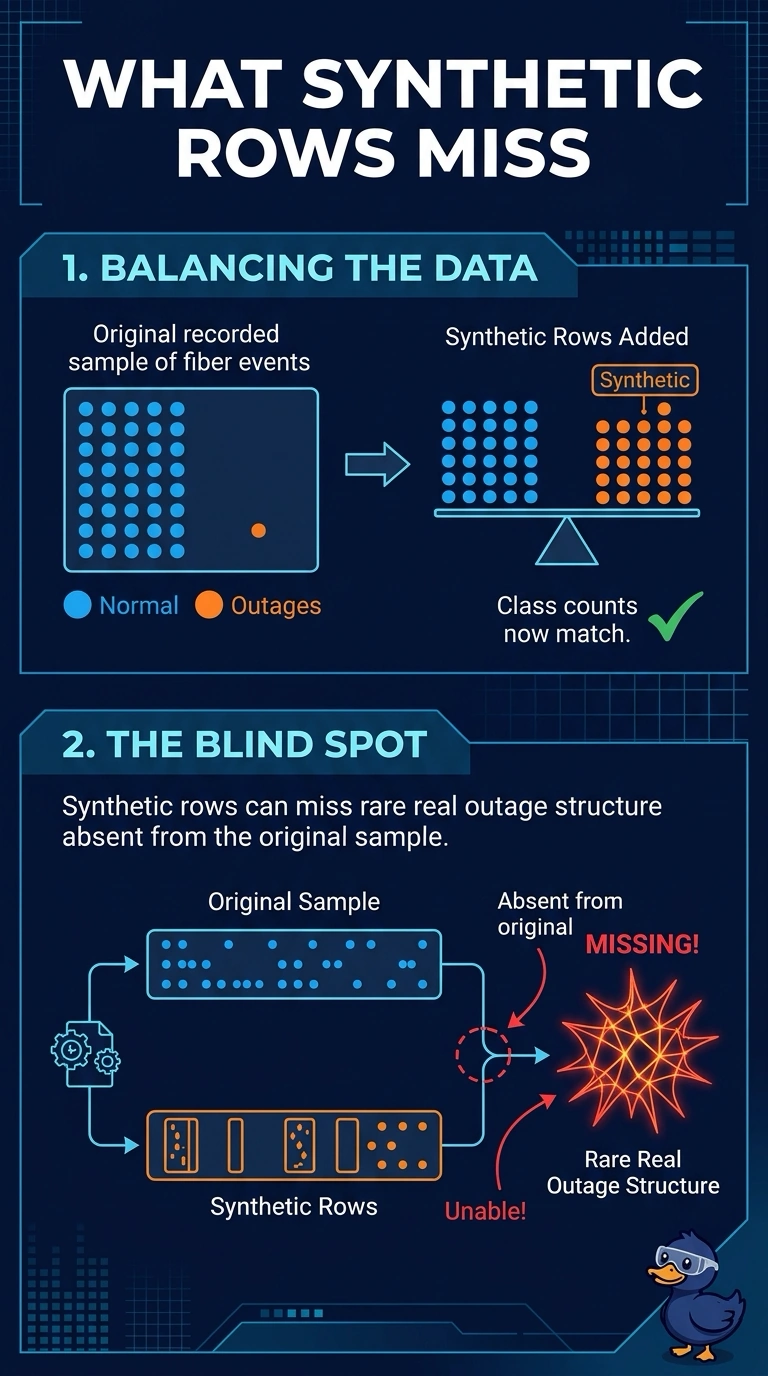
Synthetic rows can even out the pile without inventing the rare shapes you never collected. Balancing the outage counts still leaves real structure missing when the sample never held it. The trap is thinking equal counts guarantee you will catch every future outage.
Full Explanation
Synthetic rows are built from patterns already present in the observed sample. They can repeat and interpolate those patterns until the rare-outage count matches the common class, which is why the class counts now match. They cannot invent outage structure that never appeared in the original rows. A rare combination of fiber conditions that the sample missed is still missing after the counts are balanced. The limitation is that balance is not coverage of the real rare cases. The synthetic rows do not replace the observed outages. The original outages remain, and extra rows are added. The class counts do change, so it is wrong to say the table stays uneven. Matching the counts also does not guarantee that every future outage will be caught, because equal counts do not remove every sampling bias or supply the missing structure. Exam caveat: synthesis can help a learner see the minority class, and it still cannot stand in for collecting the rare events the business actually cares about. Operational check: compare the synthetic outages with the observed ones and flag any real outage pattern, known from operations, that appears in neither set.