
A power utility replaces each exact meter reading with a band such as low, medium, or high before training. Two homes in the same band become identical even when their readings differ. What did that step do?
Select an answer to reveal the explanation.
Short Explanation
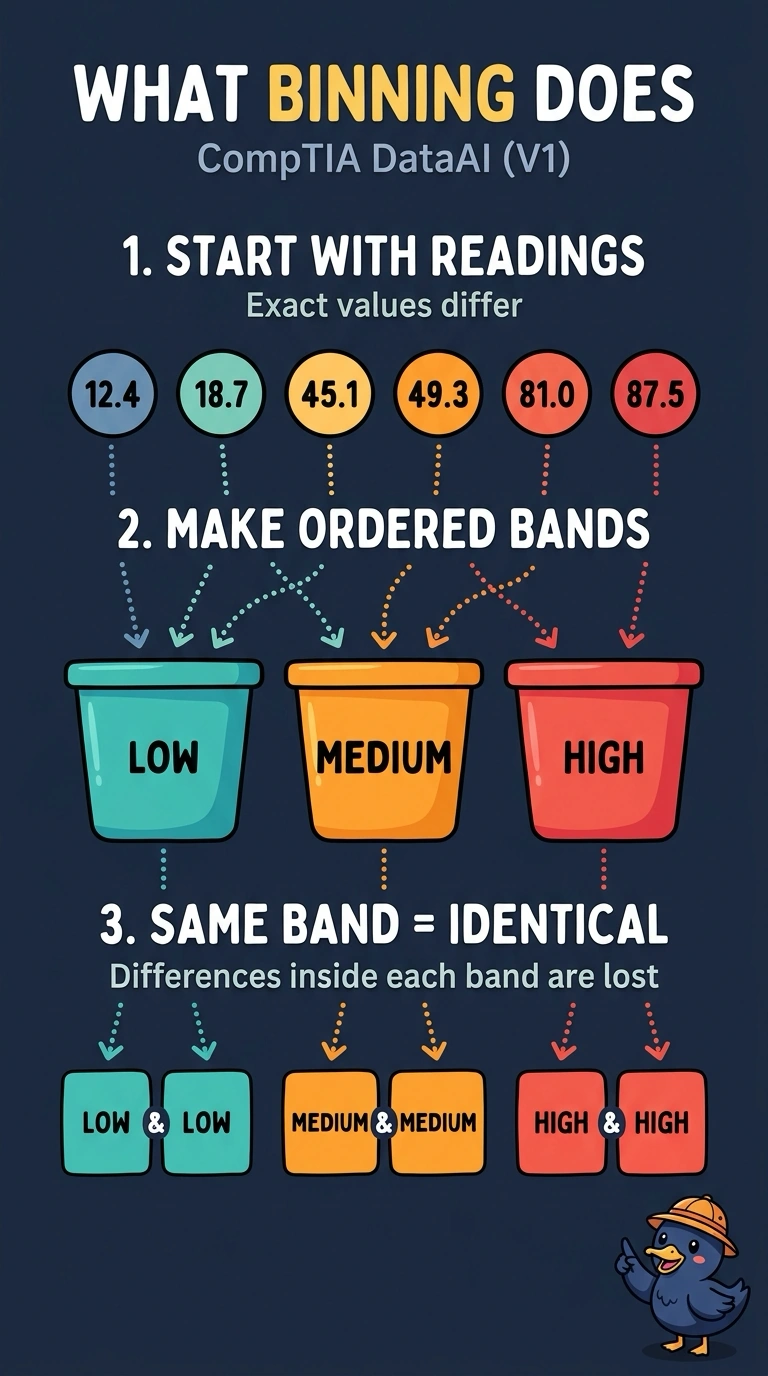
Binning is like sorting fruit into small, medium, and large and then forgetting which apple was heavier inside the box. You turned a continuous meter reading into ordered bands and threw away the within-band detail. The trap is thinking this was a z-score, which would have kept every distinct reading and only changed the scale.
Full Explanation
Binning replaces a continuous value with an ordered group label such as low, medium, or high. Every reading that falls inside a band becomes the same input, so the model can no longer see which of two homes in the medium band used more power. That loss of within-bin detail is what the utility's step did. Standardizing to zero mean and unit spread keeps every distinct reading and only changes the scale, so two different meters stay different. One-hot encoding expands an unordered category into indicator columns; the source here was a continuous reading, not a nominal label, and the result was ordered bands rather than one column per category. A logarithm keeps a distinct transformed number for each positive reading and does not place different readings into one shared group. The band labels stay in order, but that order does not put back the distinct meter readings that were collapsed inside one band. Exam caveat: bins can be useful when the decision itself is ordinal, but they are a deliberate loss of resolution, not a rescaling that can be undone. Operational check: pick two different readings that land in the same band and confirm the training table shows the same band value for both homes.