
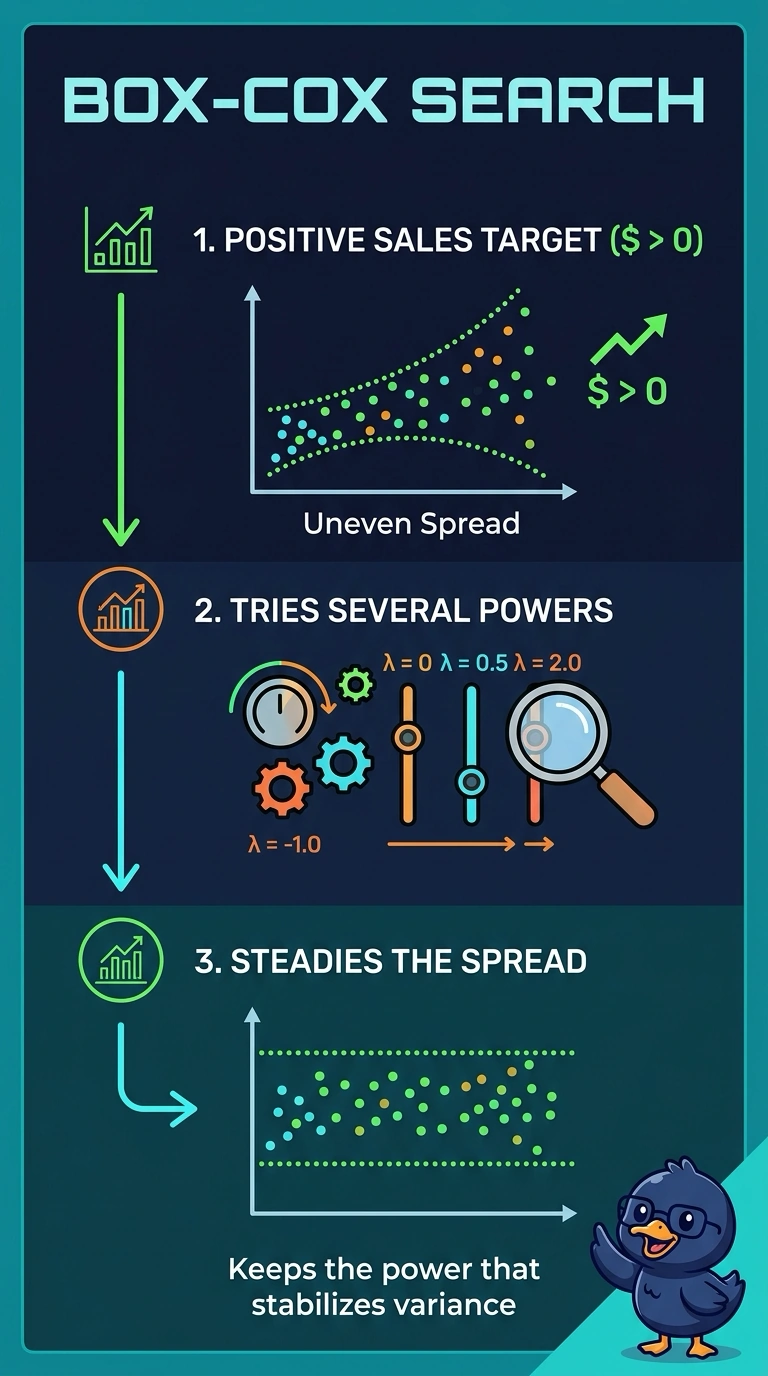
An apparel retailer sees residuals fan out as predicted demand grows. Sales are positive, and the team wants a procedure that tries several powers of sales and keeps the power that steadies the spread. Which procedure is that?
Select an answer to reveal the explanation.
Short Explanation
A fan of residuals is a sign the spread is wobbling, and you hunt for a power that calms it rather than guessing one transform. A Box-Cox search tries powers of positive sales and keeps the one that steadies the spread. The trap is a preset logarithm, which is a single power and not a search.
Full Explanation
A Box-Cox search tries a family of powers on a strictly positive target and keeps the power that makes the spread more stable, often judged by how even the residuals look or by a likelihood criterion the team chose. The apparel sales are positive, the residuals fan out as predicted demand grows, and the team asked to try several powers and keep the one that steadies the spread, so Box-Cox is the matching procedure. A single preset logarithm applies one fixed transform, the log case of that family, and does not compare other powers. A z-score forces the whole column to unit variance and does not remove a fan that widens as the prediction grows. Min-max scaling squeezes sales into a closed range and leaves that fan-shaped spread in place. The procedure being chosen is the search over exponents. A logarithm is only one power in that family, not a comparison among several powers. Exam caveat: Box-Cox is defined for strictly positive values, so zeros or returns stored as negatives have to be handled by a stated rule before the search runs. Operational check: plot residuals against fitted demand before and after the chosen power and confirm the fan flattens rather than only the units changing.