
A hospital's daily occupied-bed census drifts upward for months. Analysts replace each day's level with that day's census minus the prior day's census, and the new series no longer shows the same steady climb. What did that replacement do?
Select an answer to reveal the explanation.
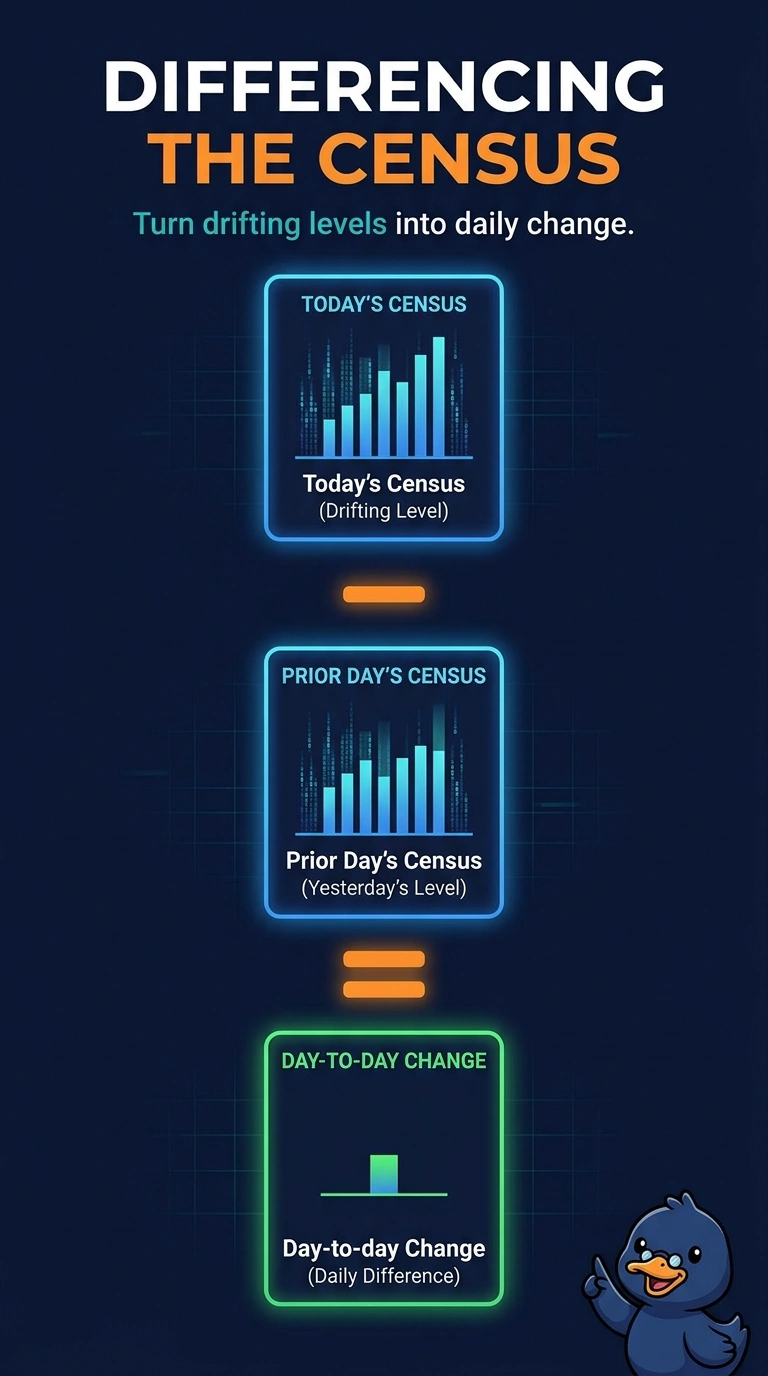
Short Explanation
Subtracting yesterday's waterline from today's shows the rise or the drop, not the depth of the lake. You replaced each census level with that day minus the day before, and the steady climb disappeared. The trap is calling that subtraction a lag of yesterday's level or a yearly seasonal adjustment.
Full Explanation
Differencing replaces a level with the change from the previous time step. If today's occupied-bed census is subtracted by yesterday's census, the new value is the day-to-day change. A series whose level drifts upward becomes a series of increments. Those increments do not carry the same steady climb, because the climbing baseline is removed by the subtraction. That is what the analysts did, and it matches the disappearance of the climb. A lag would have kept yesterday's level as a predictor beside today's level. The replacement series is the difference, not the prior level itself. A yearly seasonal adjustment would subtract the census from the same day a year earlier, or divide by a seasonal index, in order to remove a within-year cycle. Subtracting the prior day is a one-day difference, and the stem says the multi-month climb is gone, so the option that claims the climb remains is describing a different operation and a different result. Standardization subtracts a training mean and divides by a training spread. That rescales levels. It does not subtract the prior day, and it would not be described as today's census minus yesterday's census. Exam caveat: differencing a series that did not need it can inject extra serial structure, so the step is justified by the drifting level, not applied by habit. Operational check: plot the replaced series and confirm the climb is gone and that each point equals that day minus the prior day.