
A logistics team models delivery time using both route miles and the same route converted into kilometers. A correlation view shows those two predictors moving almost in lockstep, and the fitted coefficients jump sharply when either column is dropped. What problem does that view show?
Select an answer to reveal the explanation.
Short Explanation
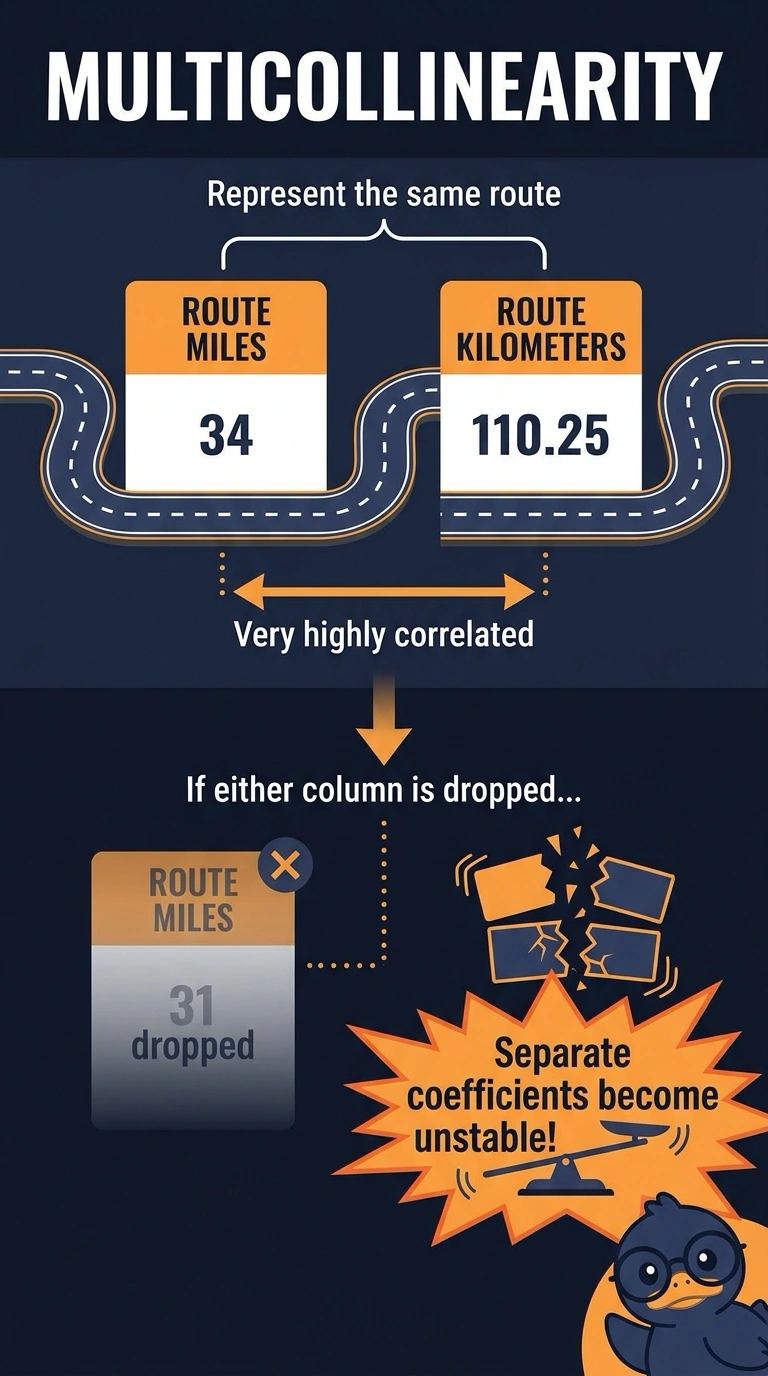
You’ve entered the same route length twice, in miles and kilometers, so the two measures agree but make it hard to tell which one drives the fitted effect. That multicollinearity makes the separate coefficients unstable when either measure is removed; the pattern is not a curve, a drifting level, or mostly zeros.
Full Explanation
Multicollinearity is very high correlation among predictors, not correlation between a predictor and the target. Miles and kilometers for the same route express the same length in two units, so they move in lockstep. The model cannot cleanly separate a mile effect from a kilometer effect, and the fitted coefficients jump when either column is dropped because the two predictors share one piece of information. That instability is the practical symptom shown by the correlation view. A curved link from distance to delivery time would appear as a bend in the outcome against distance; lockstep between two copies of distance does not create that bend. Non-stationarity means a level or spread changes over time. High correlation between two predictors is not a delivery-time level drifting from week to week, and the stem does not describe such a time pattern. A sparse mileage layout would have most entries equal to zero. Route miles and kilometers are populated measurements of real routes, duplicated rather than empty. Exam caveat: instability affects the separate coefficients and their uncertainty, while predictions relying only on the shared distance information may still look reasonable. Practical check: inspect the correlation between the predictors, then refit after dropping one unit of length; a sharp coefficient jump points to collinearity from the duplicate measurement.