
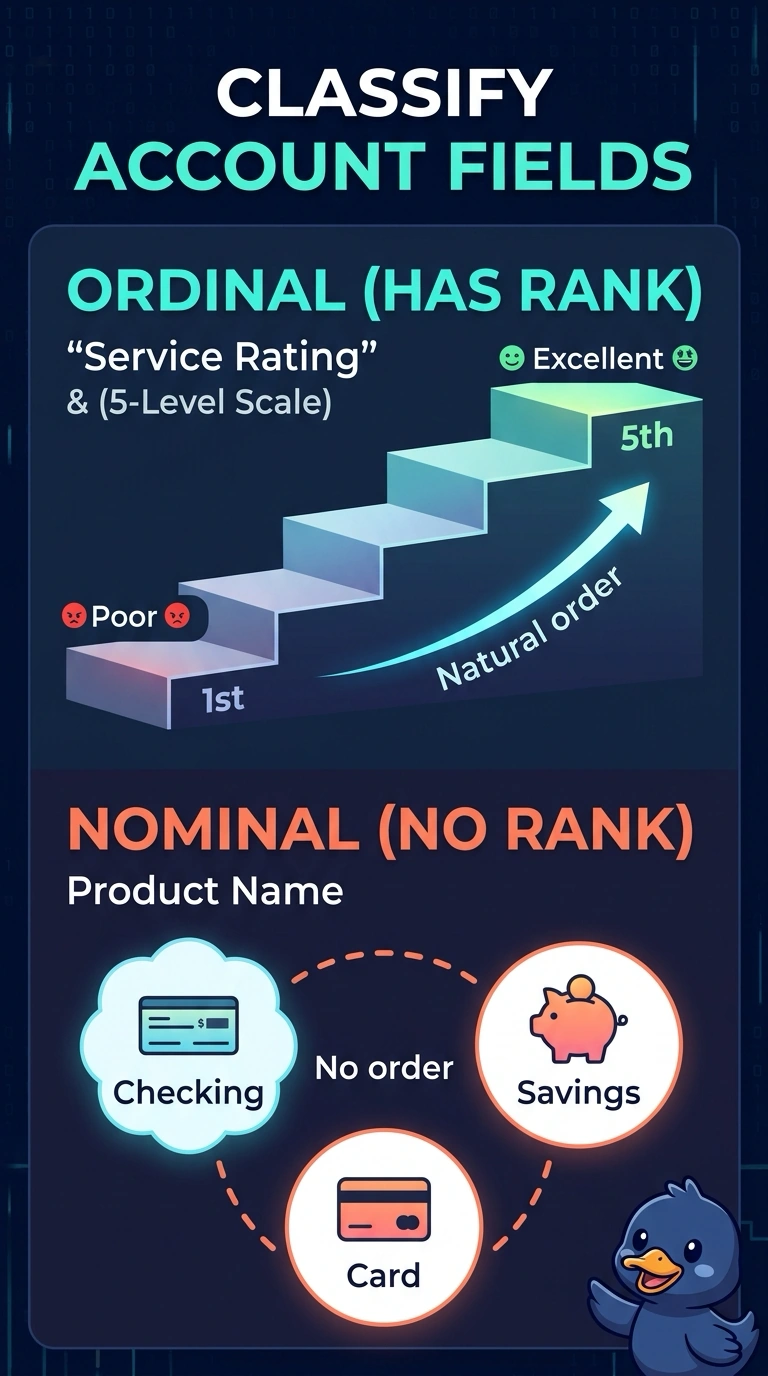
A retail bank stores a five-level service rating from poor to excellent and the product name on the account, such as checking, savings, or card. How should analysts treat those two fields?
Select an answer to reveal the explanation.
Short Explanation
A rating from poor to excellent is a ladder, and a product name is only a sticker on a bin. The trap is sorting those names alphabetically, or treating every field with several values as a rank. You should treat the rating as ordinal and the product name as nominal.
Full Explanation
An ordinal field has a meaningful order. Poor, fair, and excellent form a rank even when the gaps between levels are not equal distances, so the service rating is ordinal. A nominal field is a label with no rank. Checking, savings, and card are product names; none is more than another in the scale sense, so the product name is nominal. Treating both as nominal throws away the poor-to-excellent order that the rating actually has. Alphabetical order of product names is a sorting convenience, not a measurement scale, so it does not make the product name ordinal, and it is not a reason to put both fields in the ordinal class. Having several products does not create a rank, and storing the rating as text does not remove the order the levels already have, so swapping the two treatments reverses both definitions. Exam caveat: ordinal means ranked, not that the numeric codes for the levels are equally spaced, so a later model should not assume the step from poor to fair equals the step from good to excellent unless that spacing is established. Operational check: read the data dictionary and confirm the rating documents a rank order while the product name is documented only as an unordered label.