
A permitting agency stores whether an application is complete, recorded as yes or no, and how many inspections that application received, which may be zero, one, two, or more. How do those two fields differ?
Select an answer to reveal the explanation.
Short Explanation
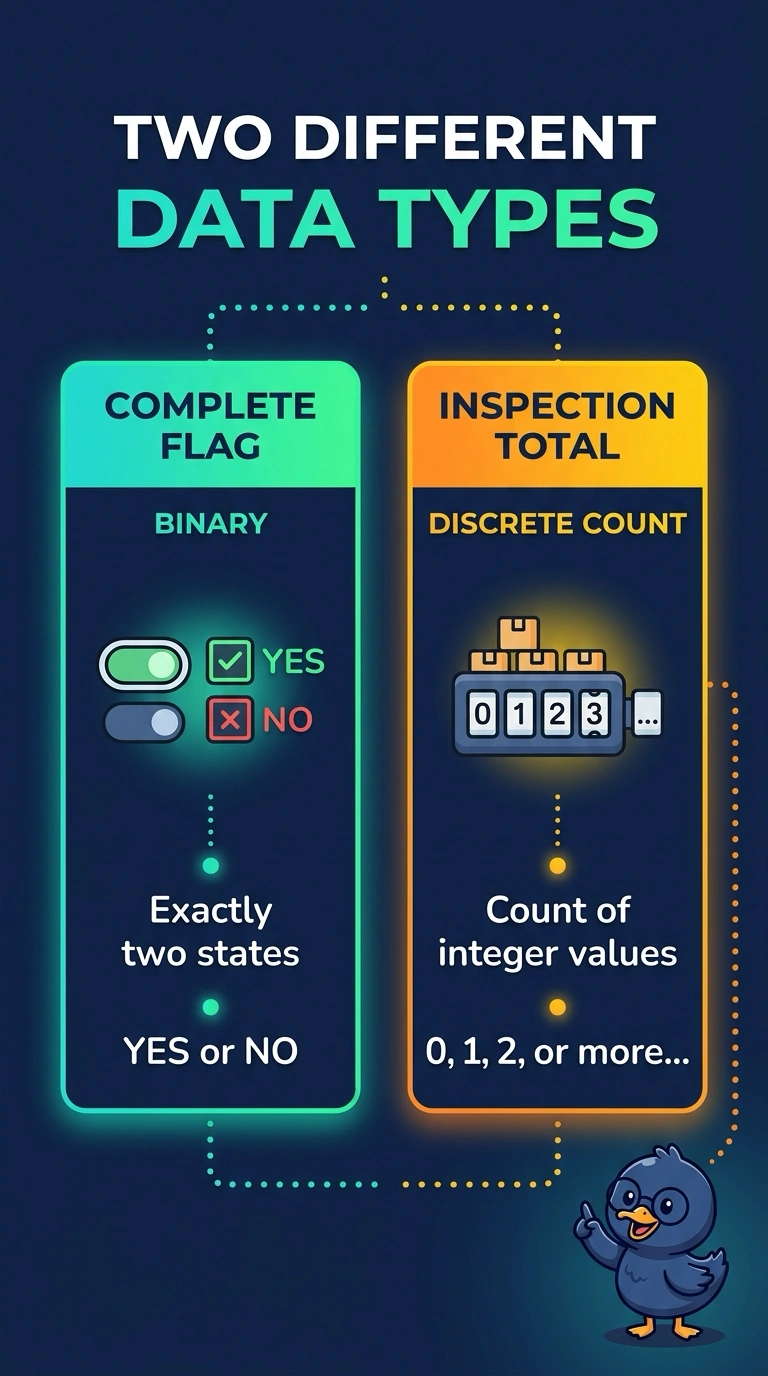
Yes or no is a light switch, while a tally of inspections is a stack of whole numbers that can keep growing. The trap is calling every whole number binary, or calling both fields continuous just because you can average them. Treat the complete flag as binary and the inspection total as a discrete count.
Full Explanation
A binary field has two states. The complete flag is yes or no, so it is binary even if a system stores those states as codes. The inspection field counts how many inspections occurred and that total can be zero, one, two, or more, so it is a discrete count: integer-valued, and not limited to two states. Calling both fields binary confuses the count with the yes-or-no result of a single inspection; the stored field is the total, which can pass two. Calling both continuous is also wrong. Averaging either field across applications does not make the values continuous measurements; one is a two-state flag and the other is an integer count. Swapping the labels reverses the definitions: a whole number is not automatically binary, and coding yes or no as zero or one does not turn the flag into a count of events that can keep rising. Exam caveat: a count is discrete, not continuous, even though its average need not be an integer. Operational check: list the distinct values of each field and confirm the complete flag has two states while the inspection field shows more than two integer values.