
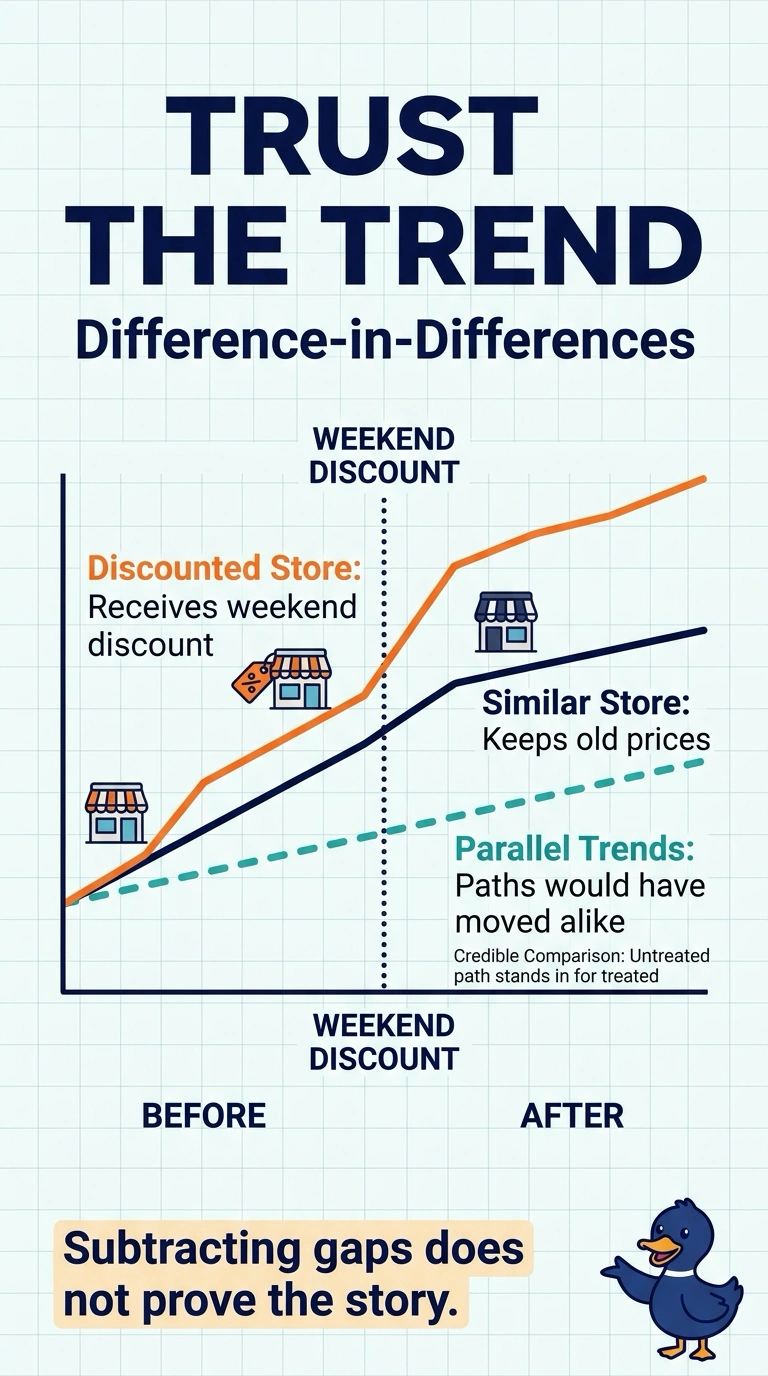
A retail group gave one store a new weekend discount and left a similar store on the old prices. Sales rose at both stores, and the discounted store rose more. An analyst wants to subtract the two before-after changes and call that gap the discount's effect. What else has to be credible?
Select an answer to reveal the explanation.
Short Explanation
Subtracting two before-and-after gaps is a clever ruler, and it still needs a story about the path you did not observe. You can read that gap as the discount's effect only when a parallel-trends story is credible, not from the subtraction alone. The trap is treating the bigger rise as proof.
Full Explanation
Difference-in-differences subtracts the untreated store's before-after change from the treated store's before-after change. That gap estimates the discount's effect only if, without the discount, the treated store would have moved in parallel with the untreated store. The untreated path is the stand-in for the treated store's missing path, and the subtraction assumes that story rather than proving it. Treating the larger rise as enough, even when the stores were already on different paths, drops the assumption the method needs. Keeping only the two after periods throws away the before path the comparison is built from and leaves a single cross-section. Starting a fresh random draw of shoppers tomorrow is a different design, and it does not make the gap already computed from these two stores credible. Exam caveat: a pre-period plot can support parallel trends and still fall short of proof, because the missing treated path is never observed. Operational check: plot both stores' sales over the weeks before the discount and judge whether those paths moved together before the prices changed.