
A transit agency models daily ridership. One term adds a coefficient times yesterday's forecast error, the shock, and does not multiply yesterday's ridership level. What is that term?
Select an answer to reveal the explanation.
Short Explanation
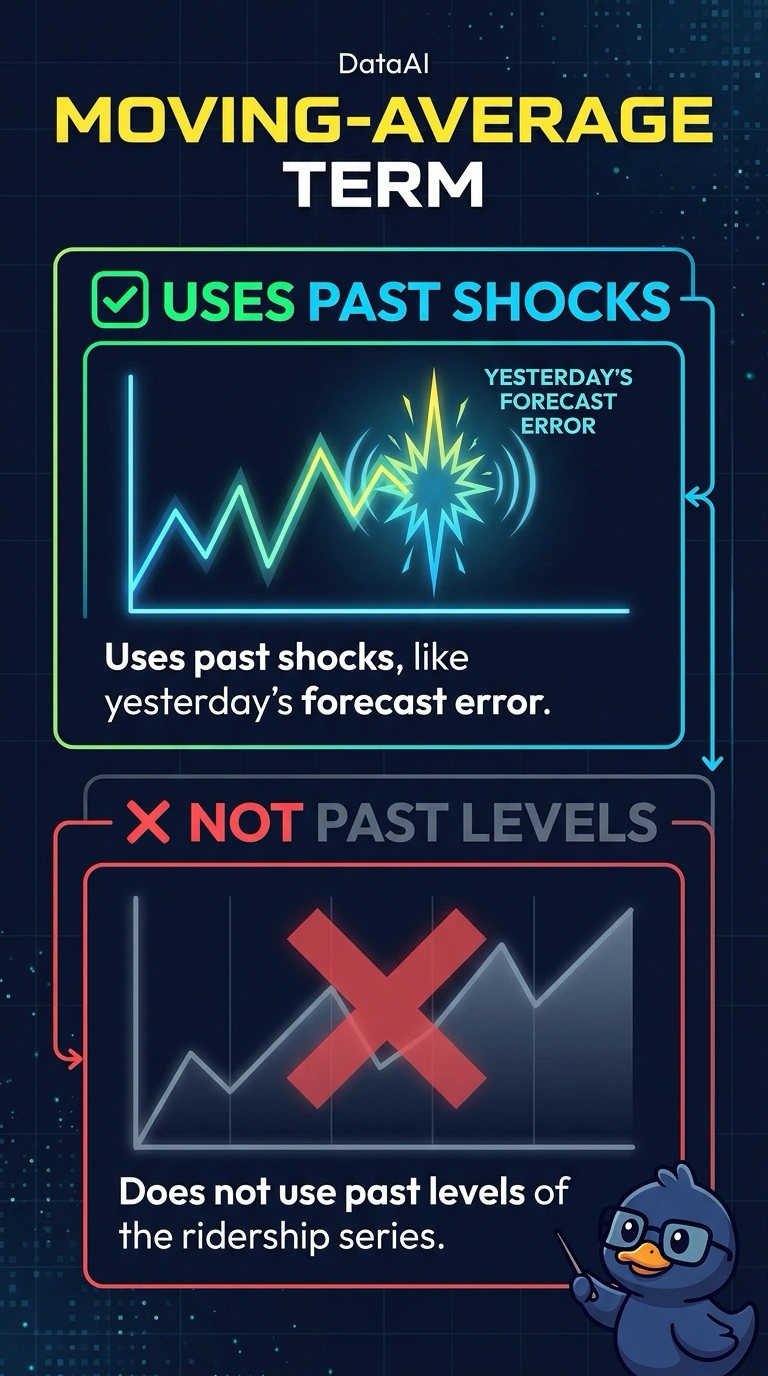
A moving-average term remembers the last surprise, not the last headcount. You are looking at a coefficient on yesterday's forecast error, a past shock, rather than on yesterday's ridership. The trap is labeling that term autoregressive, which would multiply the series' own past levels.
Full Explanation
A moving-average term in this kind of series model multiplies past shocks, the forecast errors, not past levels of the series. Yesterday's forecast error is exactly such a shock, and a coefficient on it, with no multiplication of yesterday's ridership, is the moving-average term. Naming it from the shock, rather than from the ridership level, is what separates it from an autoregressive term sitting in the same equation. An autoregressive term would multiply a past level, such as yesterday's passenger count, which the stem says this term does not do. Differencing subtracts a prior level from the current level to form a new series; it is an operation on levels, not a coefficient sitting on a past forecast error inside the model. A seasonal index repeats a calendar pattern, such as a weekday factor, and does not weight yesterday's surprise. Exam caveat: in everyday speech a moving average often means a rolling mean of past levels, but the moving-average term here is a weight on past shocks. Operational check: in the equation, confirm the term multiplies a lagged residual and does not multiply lagged ridership.