
A media company models how many days pass before a subscriber cancels. Many subscribers are still active on the day the extract is pulled, so their cancel time is unknown. How should those unfinished times be treated?
Select an answer to reveal the explanation.
Short Explanation
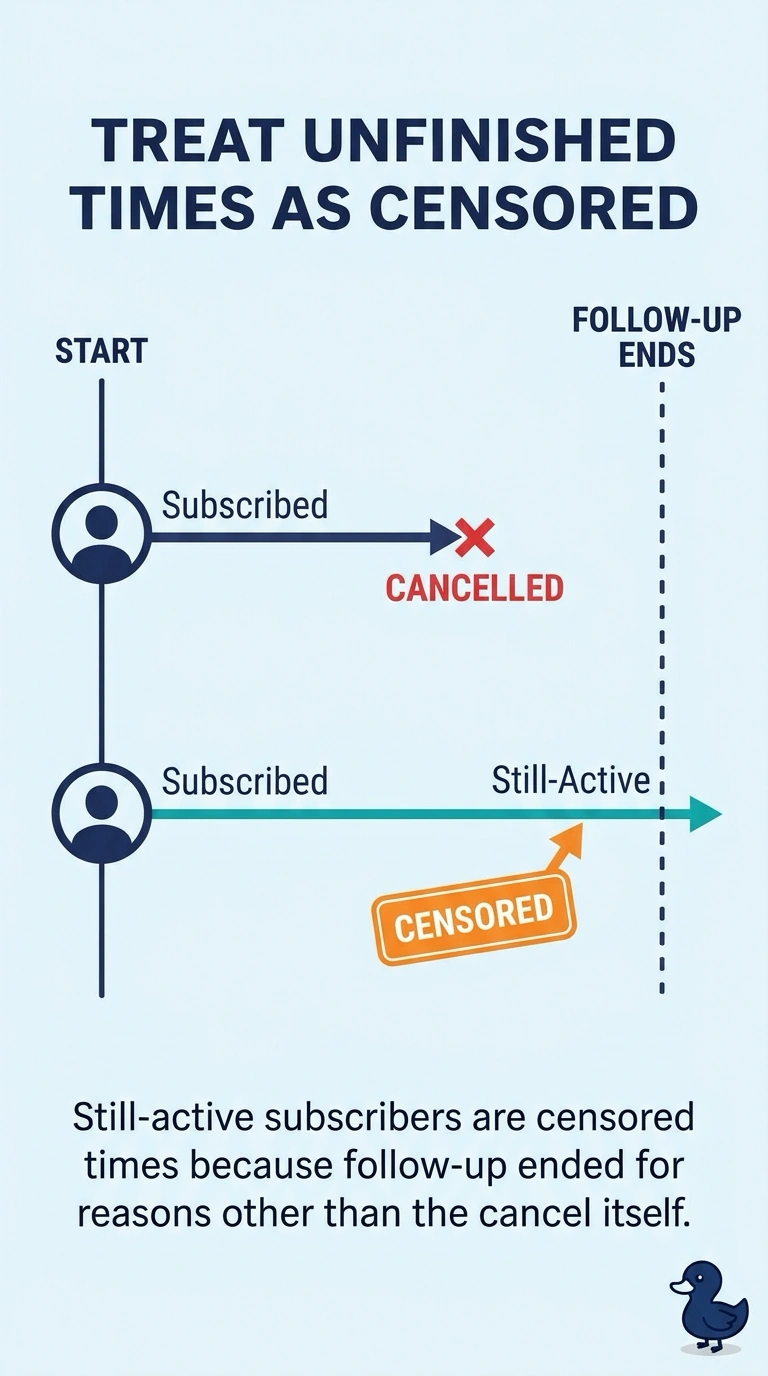
A clock that stops because the building closed did not record a finish. You keep still-active subscribers as censored times, since follow-up ended for a reason other than cancel. Dropping them, or dating the cancel at the extract, bends the timing you are trying to measure.
Full Explanation
Survival analysis studies time until an event and must retain observations whose event has not been seen. Subscribers still active on the extract date have a cancel time that is unknown because follow-up stopped, not because they canceled, so those times are censored and stay in the analysis as censored. Dropping every still-active subscriber keeps only people who already canceled and biases the timing toward shorter observed cancels. Writing the extract date as the cancel date pretends the study end was the event and shortens every unfinished subscription to that day. Replacing the unknown date with the average cancel time among people who already canceled invents events and ignores the fact that the still-active group had lasted at least until the extract. Exam caveat: treating these times as censored assumes follow-up did not stop because a cancel was imminent. Operational check: confirm the analysis file flags still-active subscribers as censored at the extract date and does not delete them or store that date as a cancel.