
An agency estimates how long job-training participants remain employed and will not assume that duration follows a named distribution such as the exponential or the Weibull. Which survival curve matches that stance?
Select an answer to reveal the explanation.
Short Explanation
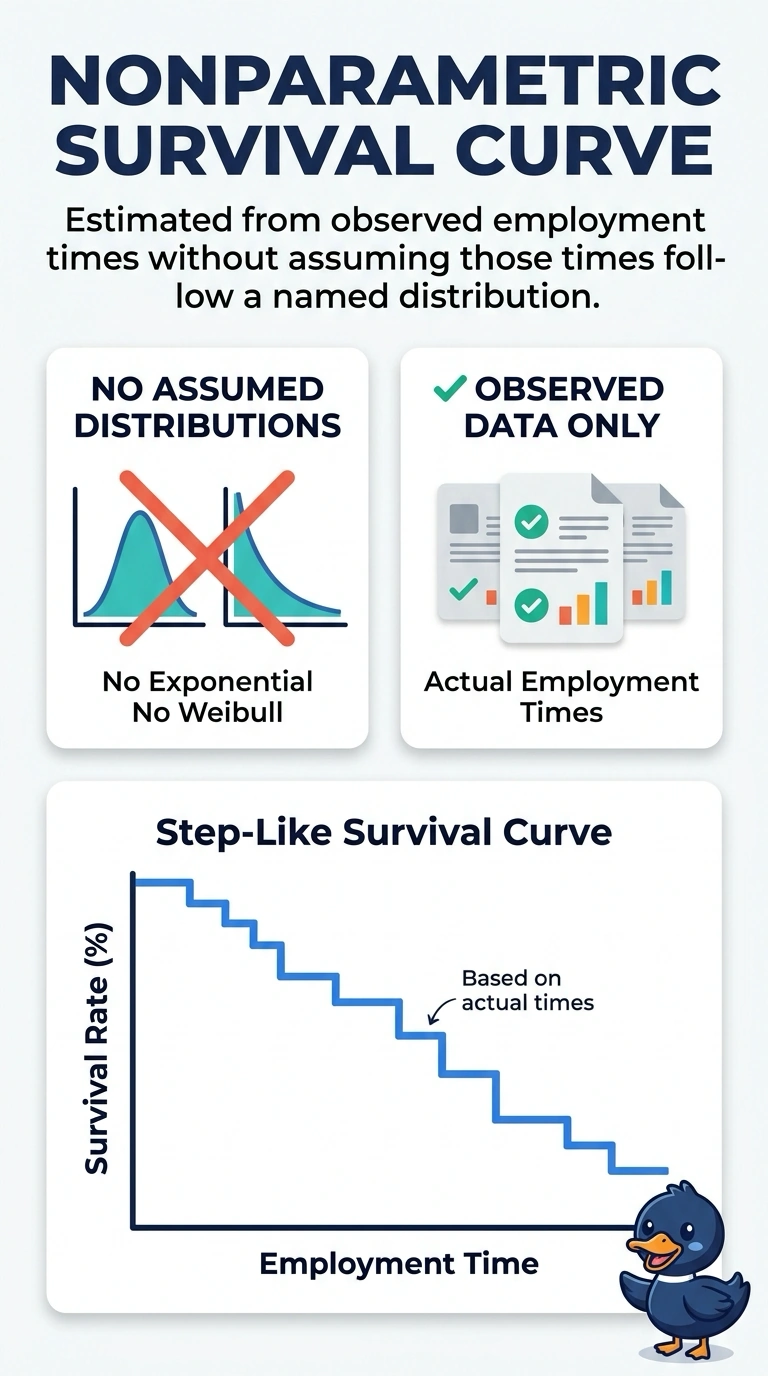
You can sketch who is still employed over time without pretending the lifetimes follow a named formula. A nonparametric survival curve stays away from an exponential, Weibull, or other named distribution. The trap is calling a model nonparametric when it still locks in one of those formulas.
Full Explanation
A nonparametric survival curve estimates the chance of still being employed from the observed times and does not assume those times follow a named lifetime distribution. Refusing the exponential and the Weibull is exactly that stance, so the curve is nonparametric. It can follow the observed exit times without a rate, shape, or scale taken from a named family. An exponential curve assumes a constant rate of leaving and is a named parametric form the agency declined. A Weibull curve fits a named shape and scale and is also parametric, so it contradicts the refusal to lock in a named distribution. A single-day cross-section of who is employed on the survey date does not estimate a time-to-exit curve at all. Exam caveat: nonparametric does not mean free of assumptions, because the usual curve still treats censoring as unrelated to the remaining employment risk. Operational check: confirm the fitted employment curve is built from the observed times and that the specification has no exponential, Weibull, or other named lifetime parameter.