
A retail science team multiplies a vector of weekly category sales by a fixed matrix. One special vector comes back as a stretched copy of itself and still points the same way. What is that vector, and which property did the multiplication just show?
Select an answer to reveal the explanation.
Short Explanation
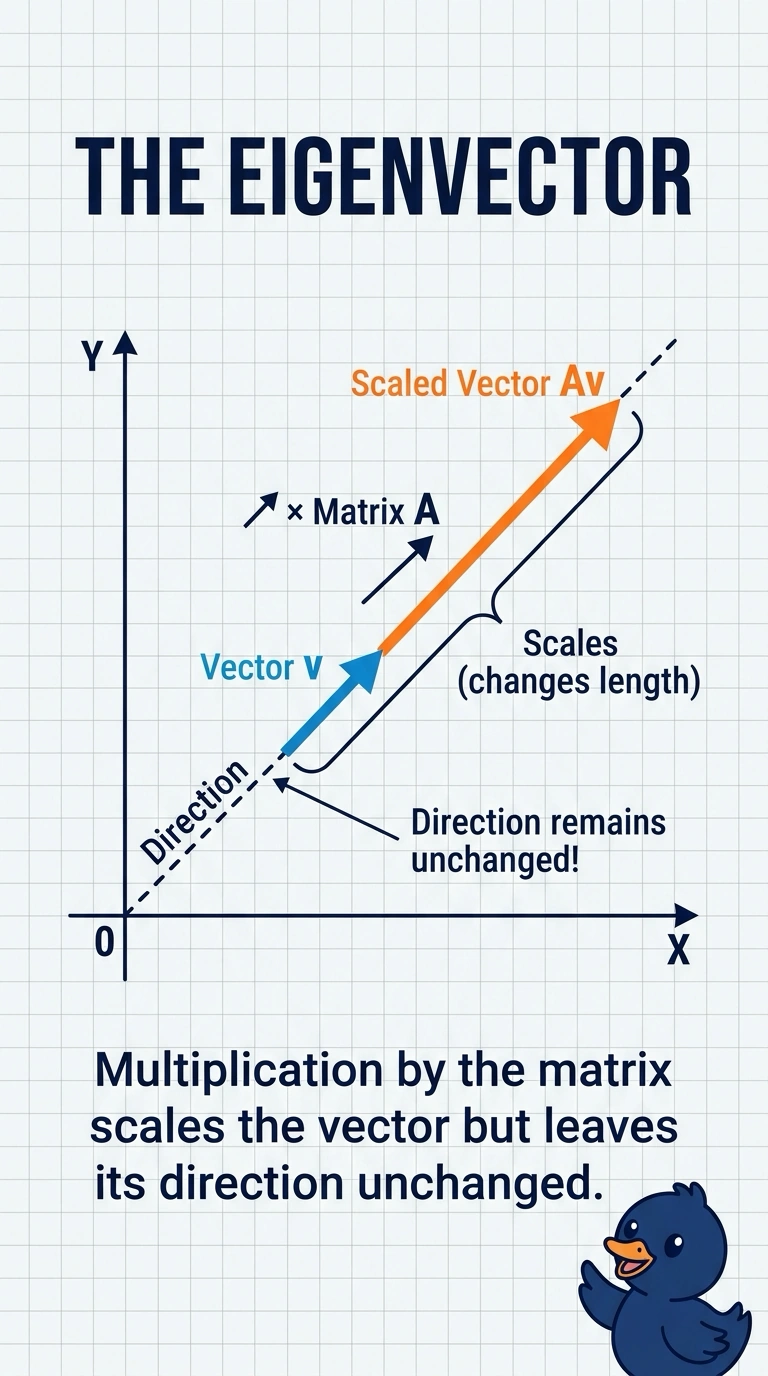
Most arrows come out of a matrix pointing somewhere new. This one comes back stretched and still aimed the same way you sent it, which makes it an eigenvector. A residual, a rank count, or a perpendicular turn is a different geometric story.
Full Explanation
An eigenvector of a matrix is a nonzero vector that the matrix maps to a scalar multiple of itself. In this case the product is a stretched copy pointing the same way, so the direction is unchanged and the vector is an eigenvector of the sales transform. A residual is what remains after a fit or a projection; multiplication does not define this vector by sending it to zero. Rank is a number, the count of independent directions, not a special sales vector whose length equals the column count. An orthogonal complement is perpendicular to a given subspace, so a map into that complement would change the direction rather than preserve it. Exam caveat: a negative scale factor reverses the vector while keeping it on the same line, and that vector is still an eigenvector; the stretch observed here is the same-direction case. A scale other than one still counts, because the test is the unchanged line, not an unchanged length. Operational check: multiply the candidate by the matrix and confirm the product equals a positive scale of the original category vector.