
A telecom engineer applies two different linear transforms, one after the other, to a signal feature vector. Reversing the order produces a different vector, and the engineer expected the order not to matter. Which property of matrix multiplication explains the mismatch?
Select an answer to reveal the explanation.
Short Explanation
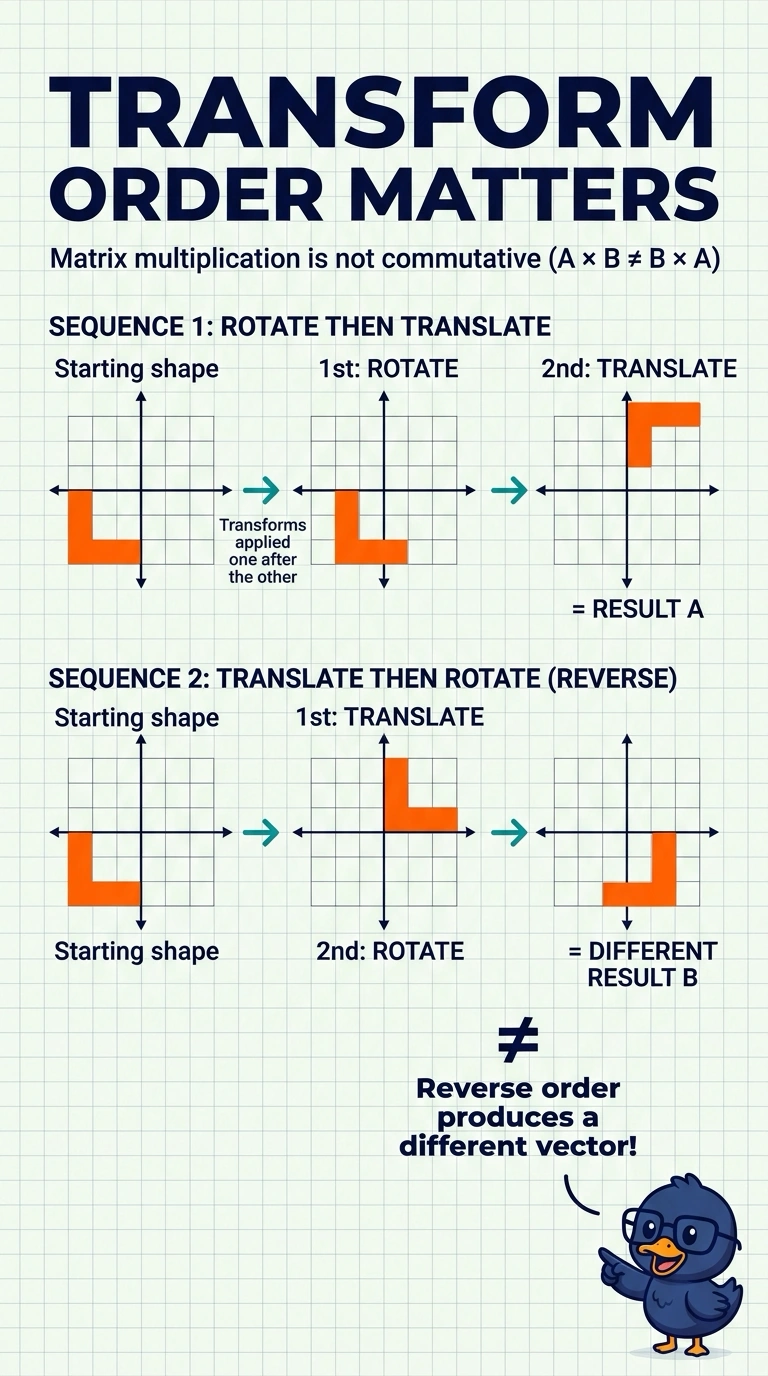
Socks then shoes is not the same operation as shoes then socks. Matrix multiplication cares about order, so your two signal transforms can produce a different vector when you reverse them. Do not blame a bad entry just because you expected the orders to match.
Full Explanation
Matrix multiplication is not commutative. The product of two transforms in one order is a different linear map, in general, from the product in the reverse order, even when both products exist and both are applied to the same feature vector. That is why the engineer sees two different results. The expectation that the orders must agree is the commutative property, and it does not hold for matrix products, so a mismatch is not by itself evidence that a transform was typed wrong. Addition of matrices does commute, which is why addition is the wrong operation to blame for an order effect. A transpose reverses the order of factors in the identity for a transposed product, but the engineer compared the two orders directly, and the products do not need a transpose to differ. Exam caveat: some special pairs do commute, such as a matrix with itself, so a single matching pair does not make multiplication commutative. Operational check: multiply two small known signal transforms in both orders and confirm the products differ on a test vector.