
A retail pricing desk defines daily revenue as a function of demand alone, and demand as a function of shelf price, then needs the derivative of revenue with respect to price. Which differentiation rule builds that derivative from the two stacked functions?
Select an answer to reveal the explanation.
Short Explanation
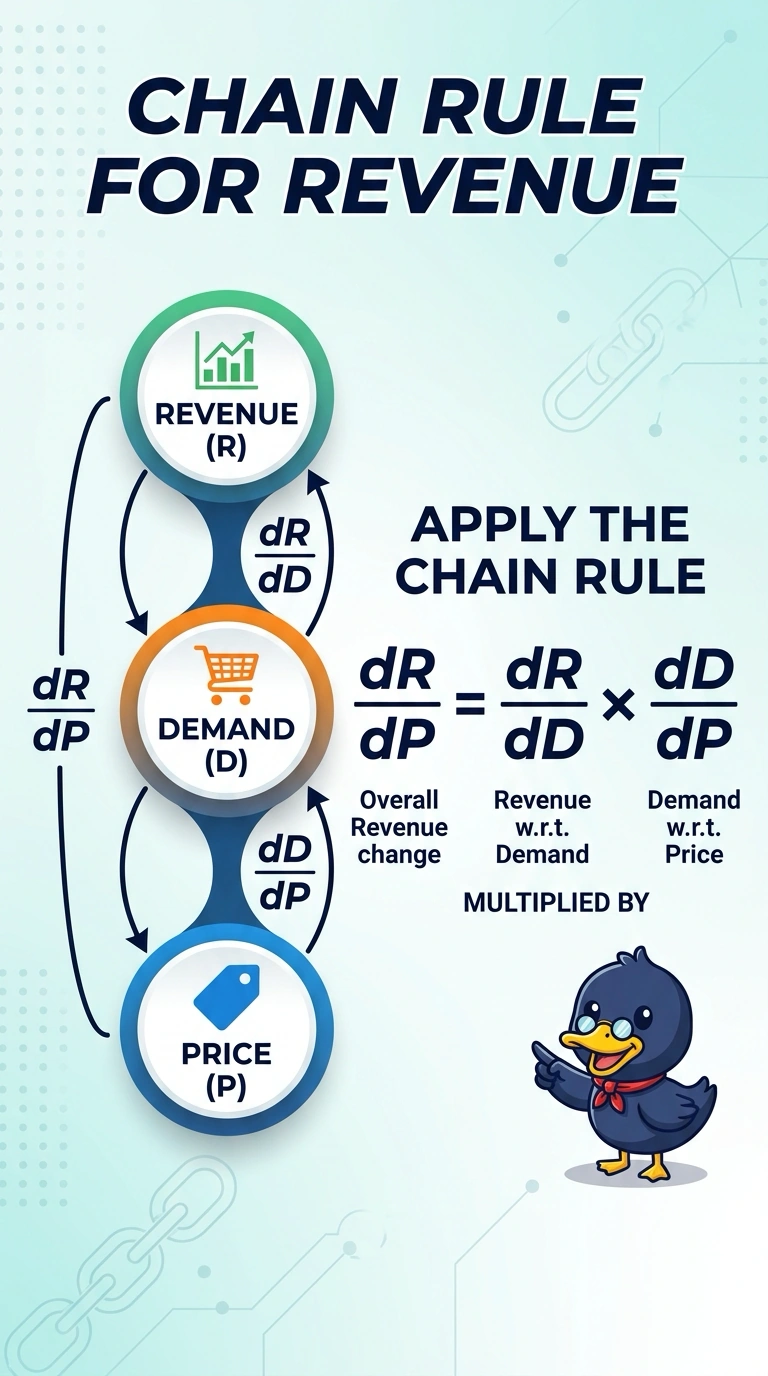
Picture two gears stacked so the top gear only moves when the bottom one turns. You get the revenue slope by multiplying those two derivatives, which is the chain rule for a composition. The trap is treating revenue as a product of price and demand when demand is the only input to revenue.
Full Explanation
Revenue depends only on demand, and demand depends on price, so a price change reaches revenue only by passing through demand. The chain rule multiplies the derivatives along that composition: the slope of revenue with respect to demand, times the slope of demand with respect to price. That product is the price sensitivity the desk needs. The product rule applies when an expression is a product of two functions of the same input and adds each factor times the derivative of the other; this revenue function is not defined as price times demand. The quotient rule fits a ratio, subtracting a cross product and dividing by the square of the denominator, a different shape than an outer function of an inner function. The power rule alone differentiates a power of the bare input and does not multiply by an inner derivative, so it drops the demand curve. Exam caveat: a formula that really is price times demand of price needs both a product and a chain, and the stem would have to say so. Operational check: confirm the implemented gradient multiplies the revenue derivative with respect to demand by the demand derivative with respect to price, rather than adding cross terms.