
A factory calibration maps a vector of sensor readings through a square matrix. Engineers want a second matrix that undoes the map and recovers the original readings exactly. When does that inverse matrix exist?
Select an answer to reveal the explanation.
Short Explanation
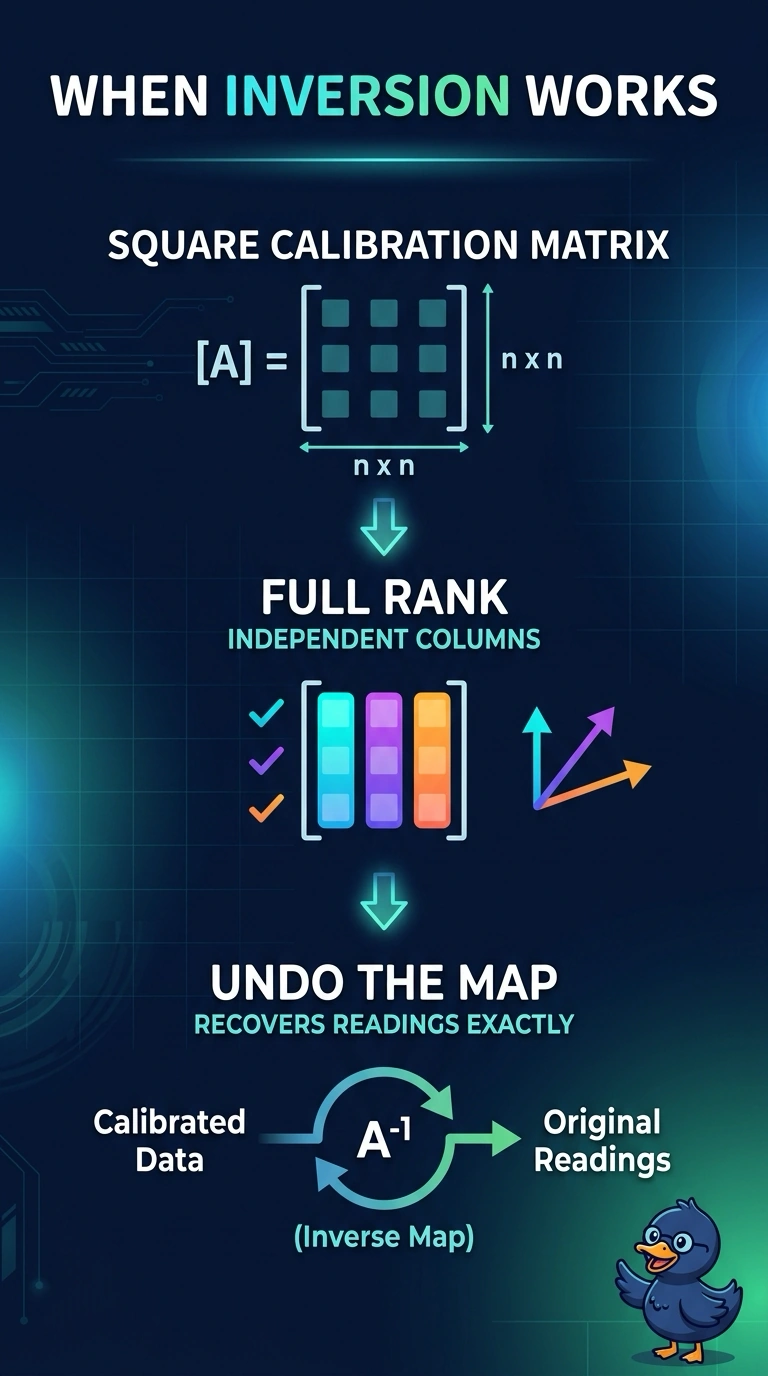
A square stamp is not automatically reversible. You can undo this calibration with another matrix only when the square matrix is full rank, meaning its columns are independent. A copied column, or a rectangular stand-in, will not give you that inverse.
Full Explanation
A square matrix has a two-sided inverse exactly when it is full rank, which means its columns are linearly independent and its determinant is nonzero. The inverse is the matrix that undoes the calibration and recovers the original sensor vector exactly. Being square is required for that two-sided inverse and is not sufficient: if one column is a scalar copy of another, the rank is short and no inverse exists. A rectangular matrix is a different object; it does not have a two-sided inverse that both undoes the map and recovers a unique reading in this square sense, and being short on rows leaves a nontrivial null space so distinct readings can share an image. Linear dependence is the condition that destroys the inverse, not the condition that creates it. Exam caveat: a one-sided inverse of a non-square matrix is a different tool and does not answer this request for a matrix that undoes a square calibration. Operational check: compute the rank and confirm it equals the number of sensor columns before accepting an inverse from the solver.