
A media studio places two cameras on a floor grid and wants the distance found by adding the absolute east-west gap to the absolute north-south gap. Which distance is that?
Select an answer to reveal the explanation.
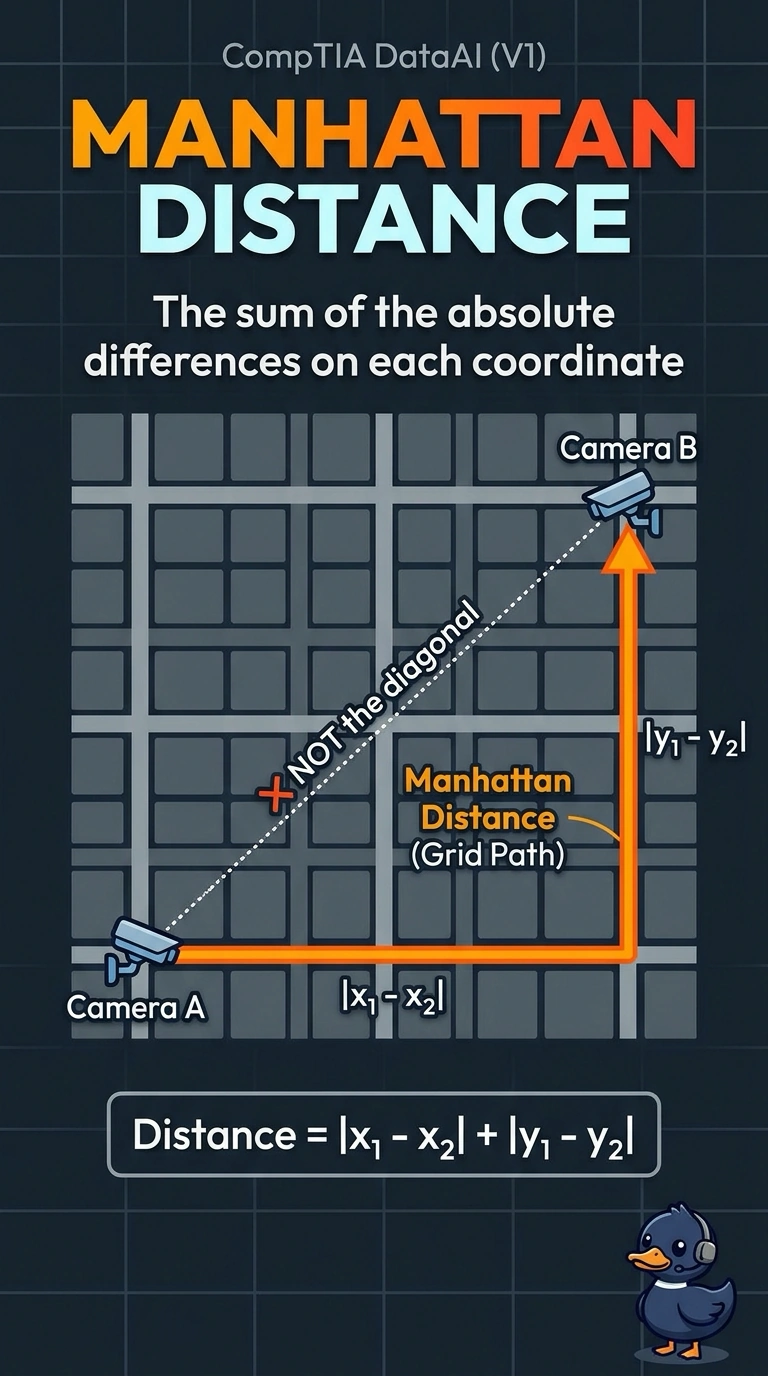
Short Explanation
City blocks make you add the east-west walk to the north-south walk instead of cutting through the courtyard. That sum of absolute gaps is Manhattan distance. The straight diagonal and a pure angle between arrows answer different questions.
Full Explanation
Manhattan distance adds the absolute gaps along each coordinate. For two cameras it is the absolute east-west difference plus the absolute north-south difference, with no squares and no square root, which is exactly the quantity the studio asked for. Euclidean distance squares those gaps, adds them, and takes the square root, producing the diagonal rather than the sum of the axis gaps. Cosine similarity divides the dot product by the product of the vector lengths, so it reports an angle and drops the separation the studio wants. A correlation of the coordinate pairs scores whether the numbers rise and fall together, and it is not a distance on the floor at all. Exam caveat: the same two points generally have a Manhattan distance at least as large as the Euclidean distance, and the two are equal only when the cameras differ along a single axis; the stem asks for the sum of absolute gaps, not the diagonal. Operational check: write the two coordinate gaps, add their absolute values, and confirm that sum is the figure being requested rather than the straight diagonal.