
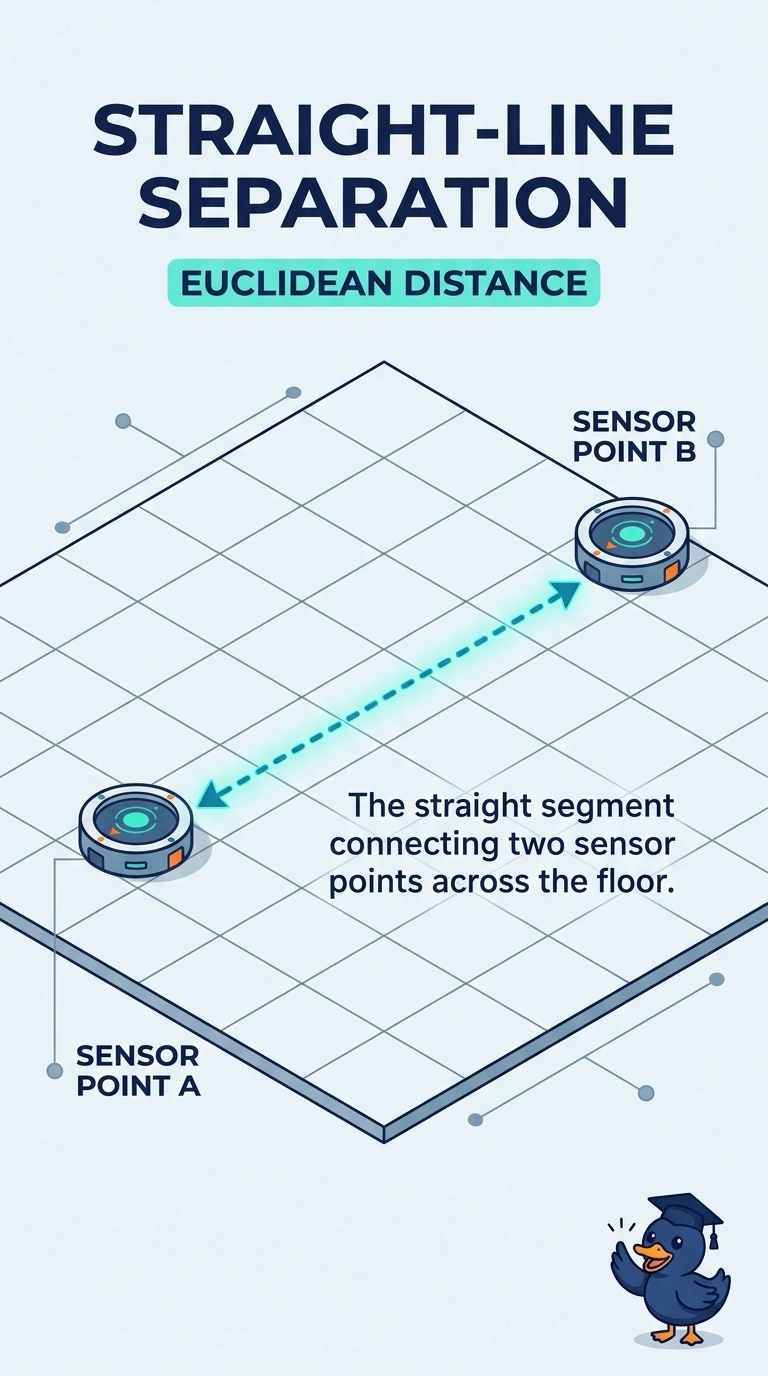
A factory engineer has two sensor locations on a flat plant-floor map and needs the straight-line separation between those points. Which distance matches that request?
Select an answer to reveal the explanation.
Short Explanation
Picture a string pulled tight between the two sensors on the plant floor. That straight run is Euclidean distance, the diagonal rather than a path that stays on the aisles. Do not reach for a block-by-block sum when you asked for the straight line.
Full Explanation
Euclidean distance is the straight-line length between two points. On a flat map it is the square root of the sum of squared gaps in each coordinate, which is the length of the segment an engineer would draw directly from one sensor to the other. Manhattan distance instead adds the absolute east-west gap to the absolute north-south gap, the length of an aisle path that never cuts the diagonal, so it answers a different request. Cosine similarity scores the angle between position vectors and cancels length, so it does not report a separation in floor units at all. A correlation of the coordinate lists measures whether paired numbers move together, not the geometric gap between two locations. Exam caveat: if the engineer had asked for walking distance along aisles, the straight segment would be the wrong tool; this stem asks for the straight-line separation. Operational check: compute both the straight segment and the aisle sum for the same pair and confirm the requested figure is the straight segment.