
A factory engineer writes three linear equations for three machine settings and then finds that every coefficient column is a scalar multiple of the first column. The solver returns a whole line of solutions instead of one setting vector. What does that column dependence imply?
Select an answer to reveal the explanation.
Short Explanation
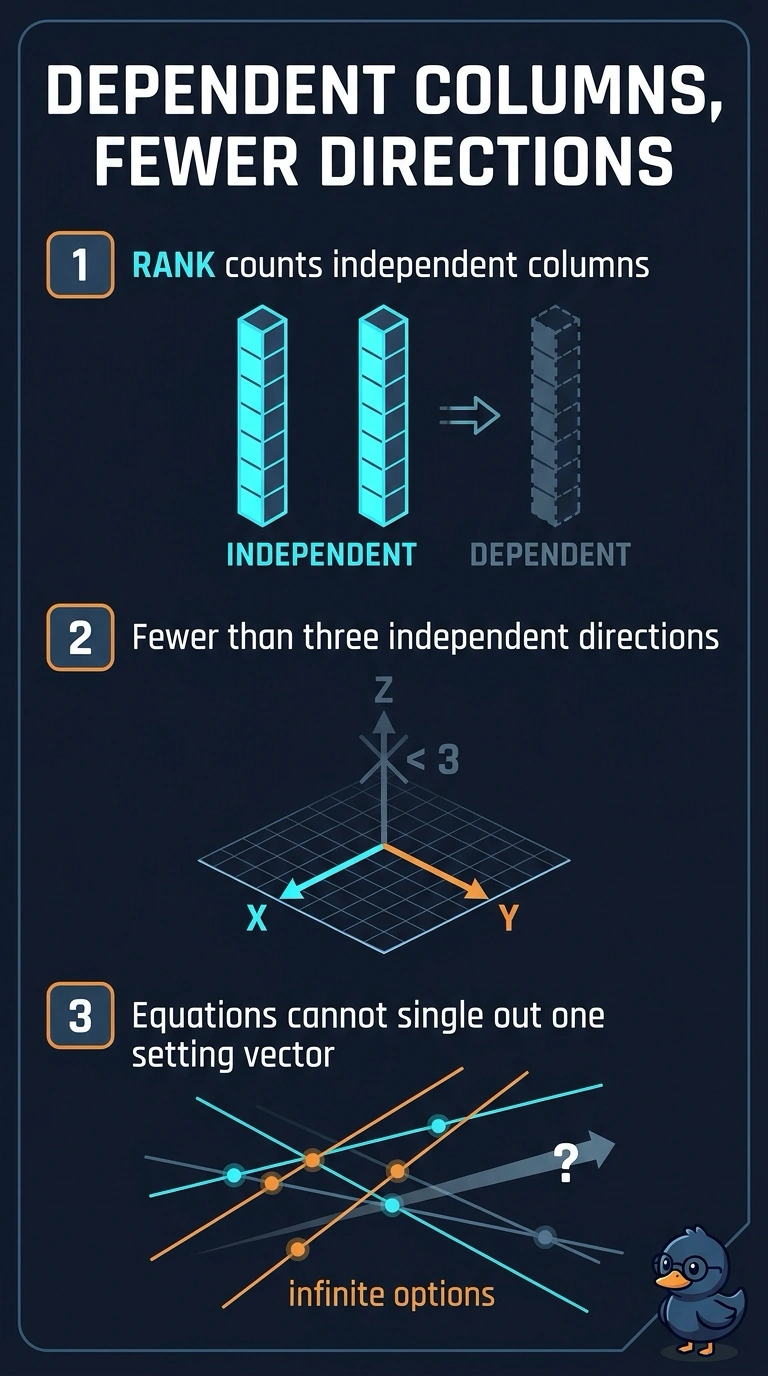
Copied columns are like duplicate keys cut from the same blank. They do not give you three independent directions, so the lock does not settle on one setting vector. A square layout is the trap; three equations are not three independent facts.
Full Explanation
Rank is the number of linearly independent columns. Here every column is a scalar multiple of the first, so the columns do not provide three independent directions and the rank is short of the three unknowns. A consistent system with that shortage has more than one solution, which is why the solver returns a line of setting vectors instead of one. Counting every row, repeated or not, overstates the rank and would falsely promise a unique setting. A square shape is not enough: a three-by-three matrix with dependent columns is singular and cannot pin down one solution. Dependence lowers the number of independent columns; it does not raise the rank above the number of unknowns or force a single vector. Exam caveat: dependence can also produce no solution when the equations disagree, but this solver returned a line, so the system is consistent and simply not unique. Operational check: compute the rank of the coefficient matrix and refuse a single reported setting vector when that rank is below three.