
An agency survey of benefit claimants must include a rare disability category that is only a small share of the population. A simple random draw might include none of those claimants. Which sampling method addresses that risk?
Select an answer to reveal the explanation.
Short Explanation
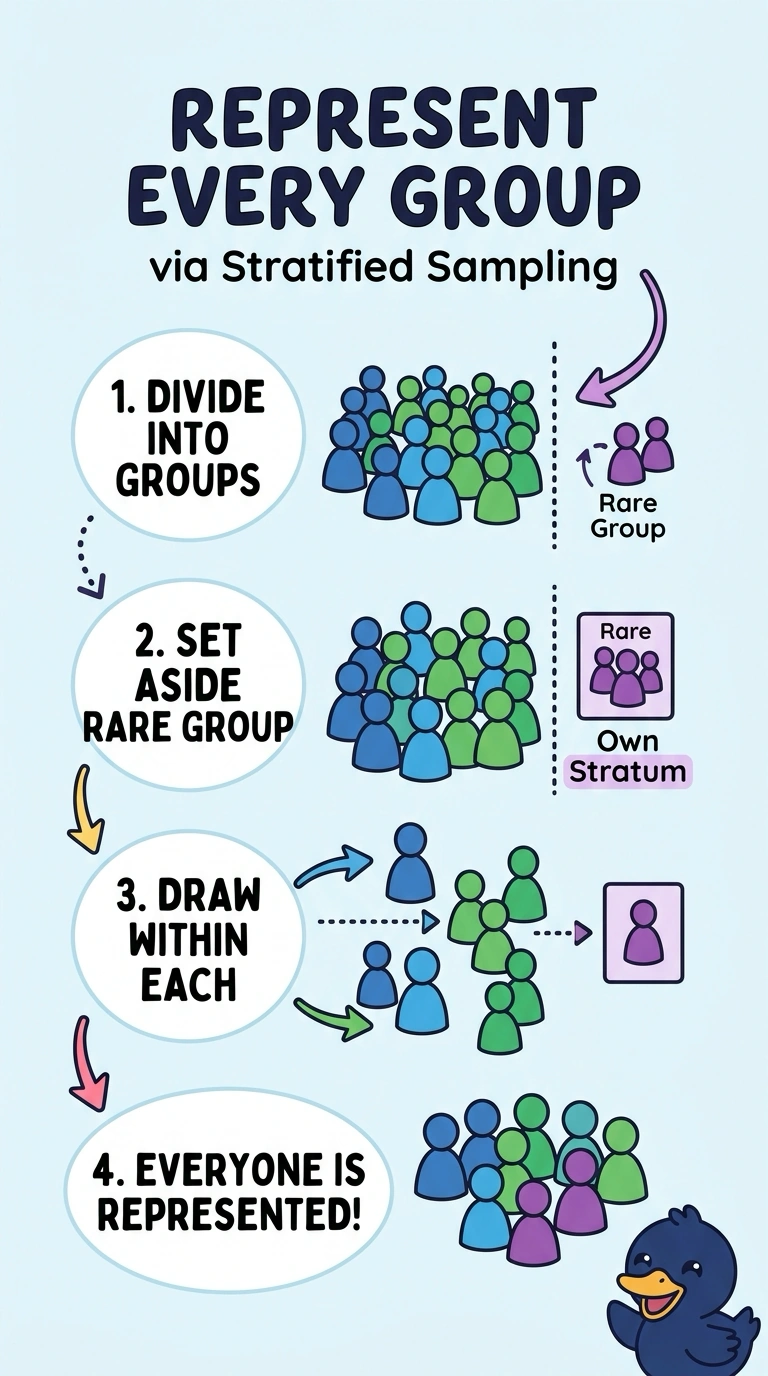
A quick handful of trail mix can miss the one piece you needed, and a simple random draw can miss a small group the same way. Stratified sampling keeps the rare disability category in the survey by drawing inside that group on purpose. Resampling a draw that already missed them will not create those claimants.
Full Explanation
Stratified sampling divides the population into strata and draws within each stratum, so a rare disability category can be selected on purpose instead of left to chance. Giving that category its own stratum keeps it represented even when a simple random draw of the same size might contain none of those claimants. A convenience sample of one office in one week follows whoever walks in and does not guarantee the rare category. A bootstrap redraw of a sample that already missed the category only repeats that miss, because resampling cannot invent claimants who were never drawn. A voluntary web poll represents people who choose to respond, which can skip the rare category entirely. Exam caveat: stratification guarantees representation only for strata that are defined and sampled; it does not fix a list that omitted the group before the strata were drawn. Operational check: confirm the design includes a stratum for the rare category and that the selected sample contains claimants from that stratum before fieldwork closes.