
A media research group has one survey sample and wants to see how much a mean rating would move if that sample had been drawn again. No new survey can be fielded. Which procedure fits?
Select an answer to reveal the explanation.
Short Explanation
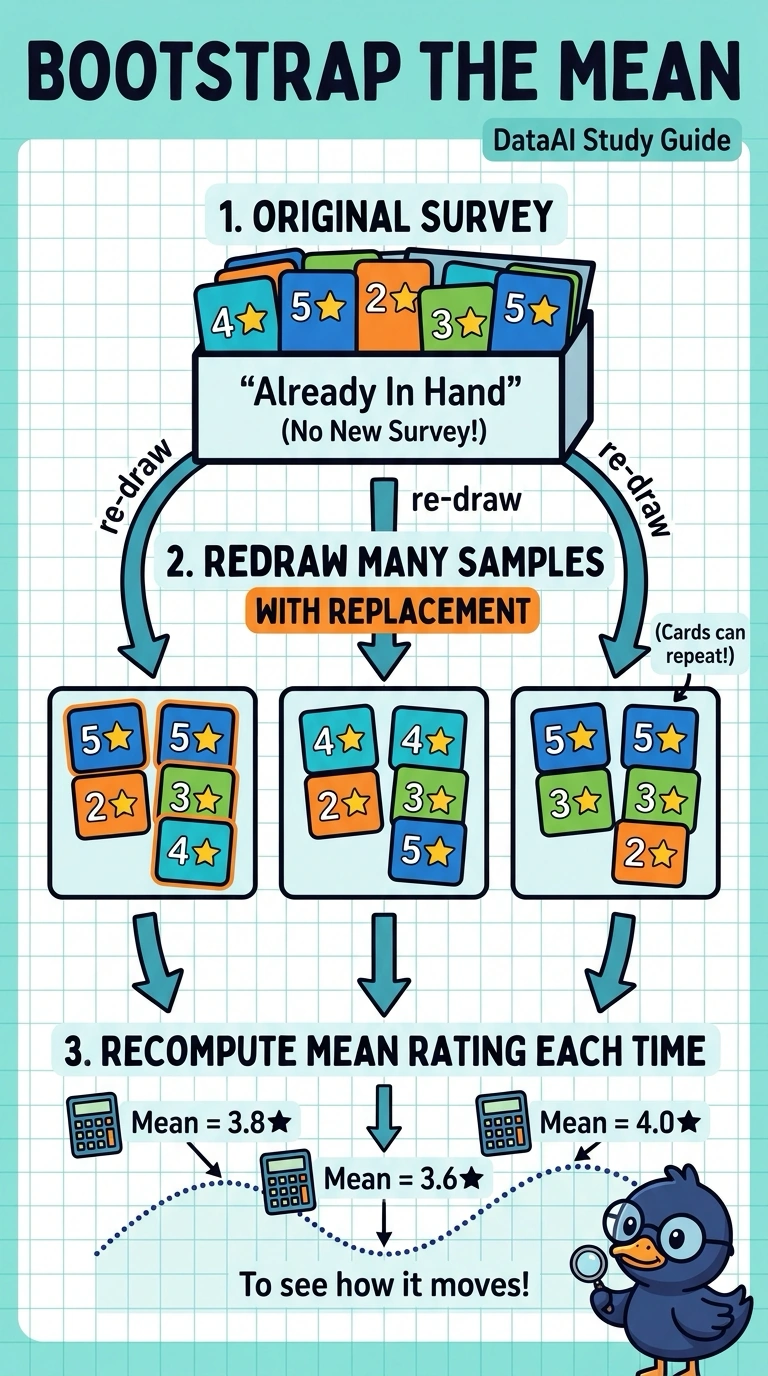
A bootstrap is a dress rehearsal that reuses the one audience you already surveyed. You redraw samples with replacement and watch how the mean rating moves. A train-test split answers a prediction question, and it cannot invent a new survey.
Full Explanation
The bootstrap treats the observed survey as a stand-in for the population and redraws many samples with replacement from those same respondents. Recomputing the mean rating on each redraw shows how that statistic moves from sample to sample when a new survey cannot be fielded. A train-test split holds out rows to estimate prediction error and does not build a sampling distribution for the mean. A new stratified survey would draw new people within groups, which the group cannot do because no new fieldwork is allowed. Deleting incomplete responses changes the analysis set once and never resamples it to see the mean move. Each redraw is taken with replacement, so some respondents appear more than once and others drop out, and the mean is computed again on that new mix. After many redraws, the spread of those means is a picture of sampling movement for this survey, built without contacting anyone new. A prediction split and a one-time deletion never build that list of means. Exam caveat: the bootstrap only reshuffles the sample in hand, so it cannot repair a sampling frame that missed an entire audience segment. Operational check: draw repeated with-replacement samples from the current responses, recompute the mean each time, and summarize the spread of those means.