
A bank wants the probability that a loan's loss rate lands at or below a stated cutoff, not the density sitting at that cutoff alone. Which function returns that probability directly?
Select an answer to reveal the explanation.
Short Explanation
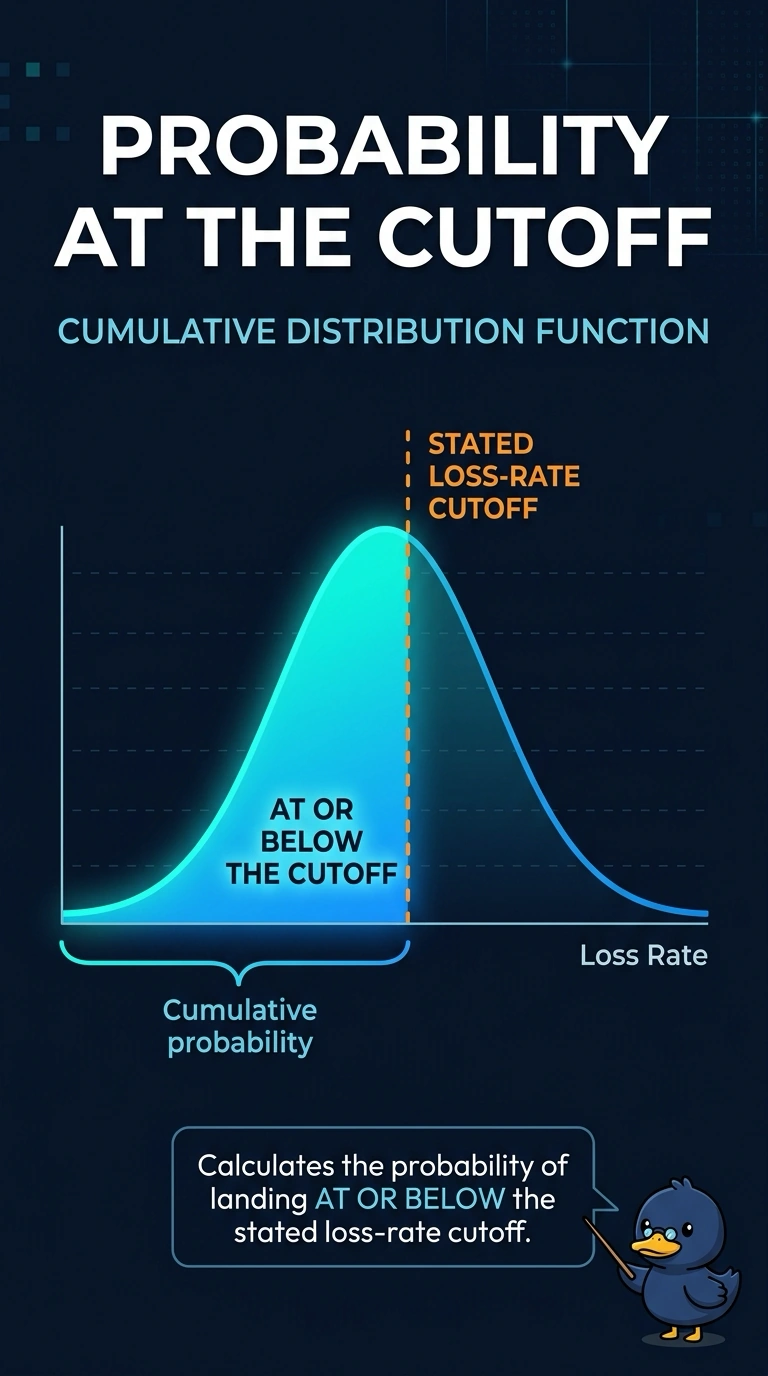
A cumulative distribution is the running total of probability up to a cutoff, which is what you want for at-or-below. The density at the cutoff is a different question, and the quantile function runs the lookup backward. Do not swap those tools.
Full Explanation
The cumulative distribution function at a cutoff is the probability that the random loss rate is less than or equal to that cutoff. That is the at-or-below probability the bank asked for, read directly from the function without integrating a density by hand. A probability density function describes how probability is concentrated along the loss-rate axis. For a continuous loss rate the height at the cutoff is not the probability of landing at or below it, and the probability of the single point itself is zero. The hazard function is an instantaneous event rate among loans that have not yet had the event. It is a survival concept, not the cumulative probability of a loss rate. The quantile function runs the relationship backward: given a probability, it returns the cutoff that has that much probability at or below it. The bank already has the cutoff and wants the probability. Exam caveat: for a discrete loss rate the cumulative function includes the probability mass at the cutoff, which is the at-or-below reading. Operational check: evaluate the cumulative function at the stated cutoff and confirm it equals the share of historical loans whose loss rate is at or below that cutoff.