
At a factory, a temperature sensor omits a reading more often when the true temperature is extremely high, and that high value is the one absent from the log. How should the team describe this missingness?
Select an answer to reveal the explanation.
Short Explanation
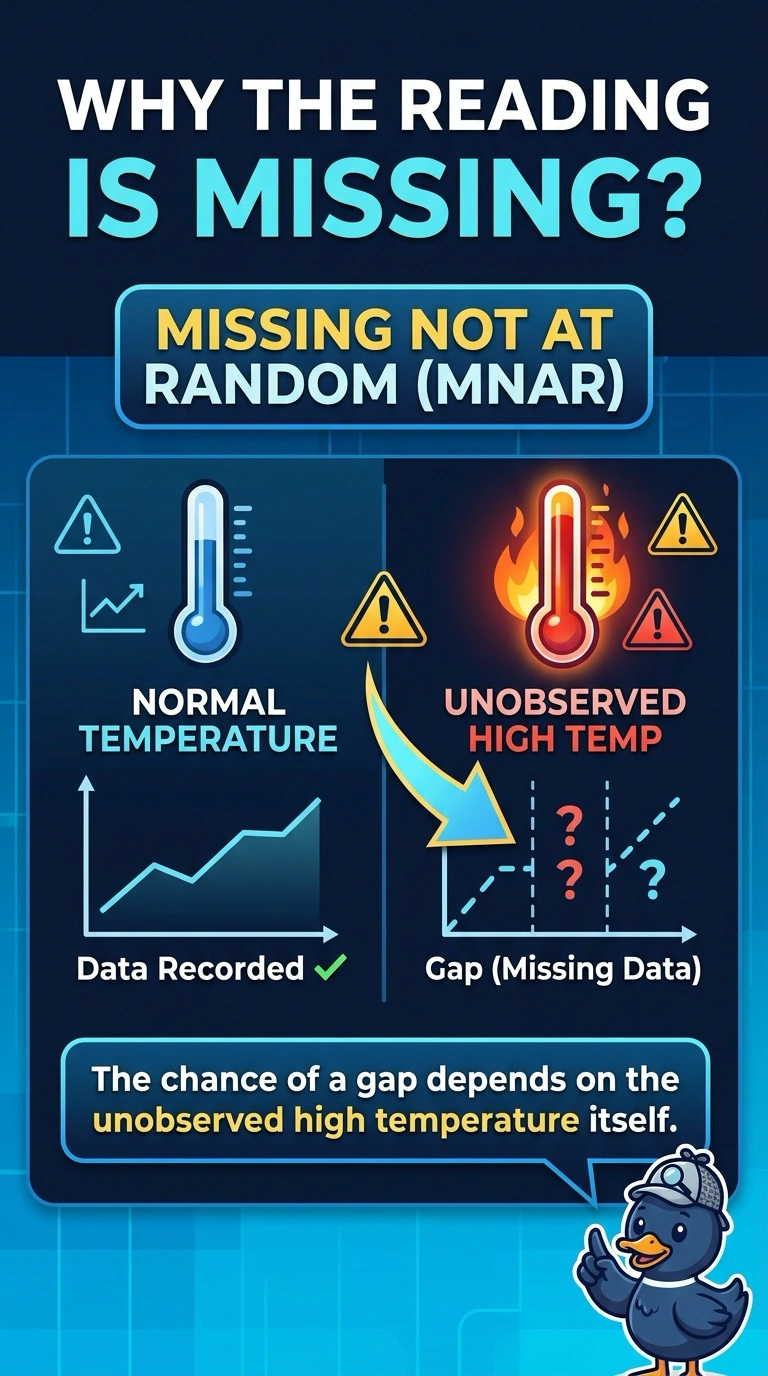
If the thermometer stays silent exactly when the room is hottest, the absence is telling you about the value you cannot see. That pattern is missing not at random, unlike a gap with no tie to the temperature. Do not call it completely random just because a sensor failed.
Full Explanation
Missing not at random means the probability that a value is absent depends on the unobserved value itself. Here the sensor drops a reading more often when the true temperature is extremely high, and that high value is precisely the one missing, so the mechanism is missing not at random. Missing completely at random would mean the gap has no tie to the temperature or to any other data, which contradicts a failure that tracks extreme heat. Missing at random would mean the gap is explained by other columns that were observed, not by the missing temperature; the stem gives the unobserved temperature as the driver. Structurally absent data cannot exist because the measurement was never possible, but this sensor is installed and simply fails to record its hottest moments. Exam caveat: if a second, fully observed sensor accounted for every gap, the description would shift toward missing at random. Operational check: compare how often readings are missing in cooler stretches versus stretches where other evidence shows extreme heat, and confirm the gaps concentrate on the high unobserved values.