
A utility inspected 200 transformers. Forty of them later failed. Thirty of those 40 failures had a prior hot-spot alert, and 20 of the 160 healthy units had the same alert. Using Bayes' rule on these counts, what is the probability a transformer failed given that it had shown the alert?
Select an answer to reveal the explanation.
Short Explanation
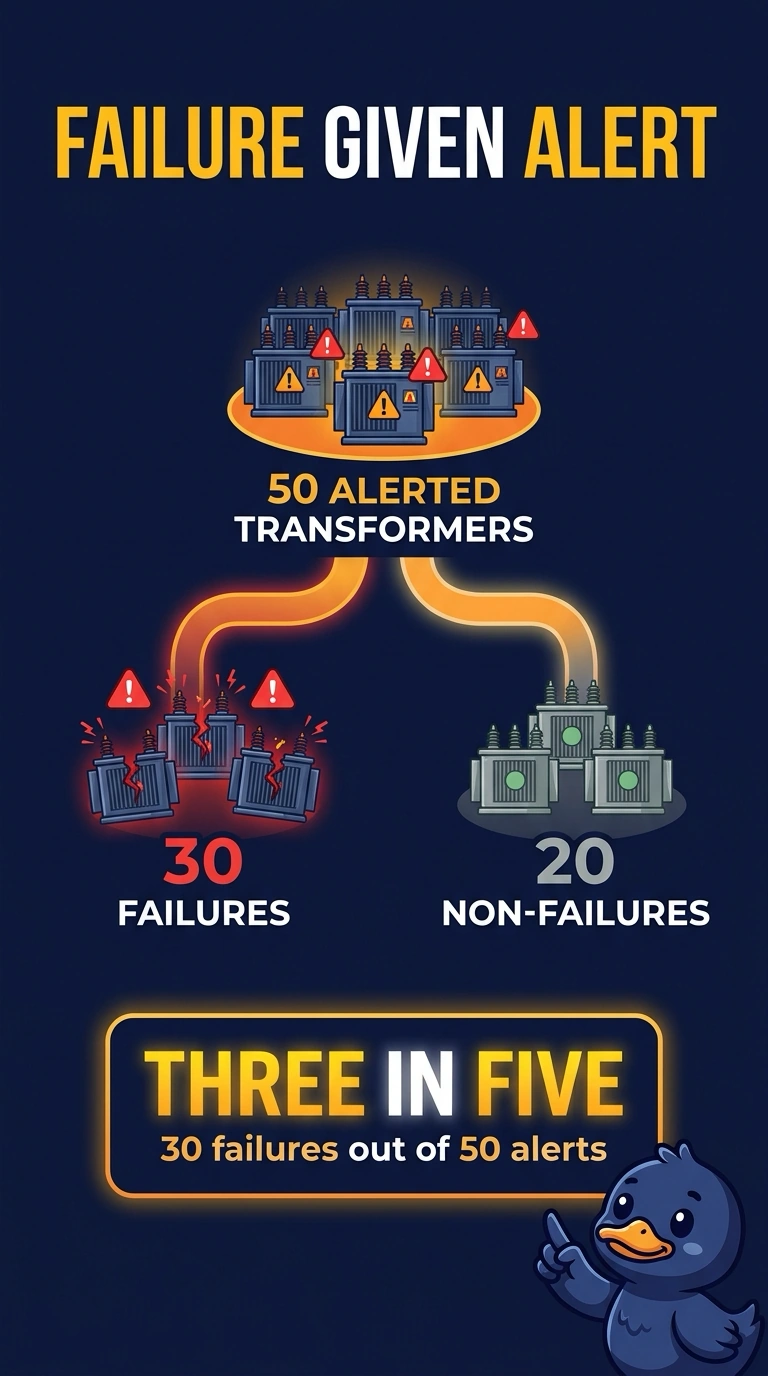
Bayes' rule here is just careful counting among the alerted transformers, which you can do with the inspection totals. Thirty of the fifty alerted units failed, so the probability you want is three in five. The trap is reporting the failure base rate, the reversed conditional, or the alert rate.
Full Explanation
Fifty transformers showed the alert, because 30 of the failures and 20 of the healthy units had it. Thirty of those 50 alerted units later failed, so the probability of failure given an alert is 30/50, which is three in five. Bayes' rule reaches the same fraction: the probability of an alert given failure is 30/40, the probability of failure is 40/200, and the probability of an alert is 50/200. Multiplying 30/40 by 40/200 and dividing by 50/200 cancels to 30/50. One in five is 40/200, the base rate of failure among all inspected units, and it ignores the alert. Three in four is 30/40, the probability of an alert given failure, which reverses the conditional the question asked. One in four is 50/200, the probability of the alert itself, not the probability of failure among the alerted units. Exam caveat: the conditional runs from the evidence to the event of interest, so the denominator is the count of alerted transformers, not the count of failures and not the full inspection. Operational check: list the 50 alerted units and count how many are among the 40 failures. That count should be 30, and 30 divided by 50 should be the reported probability.