
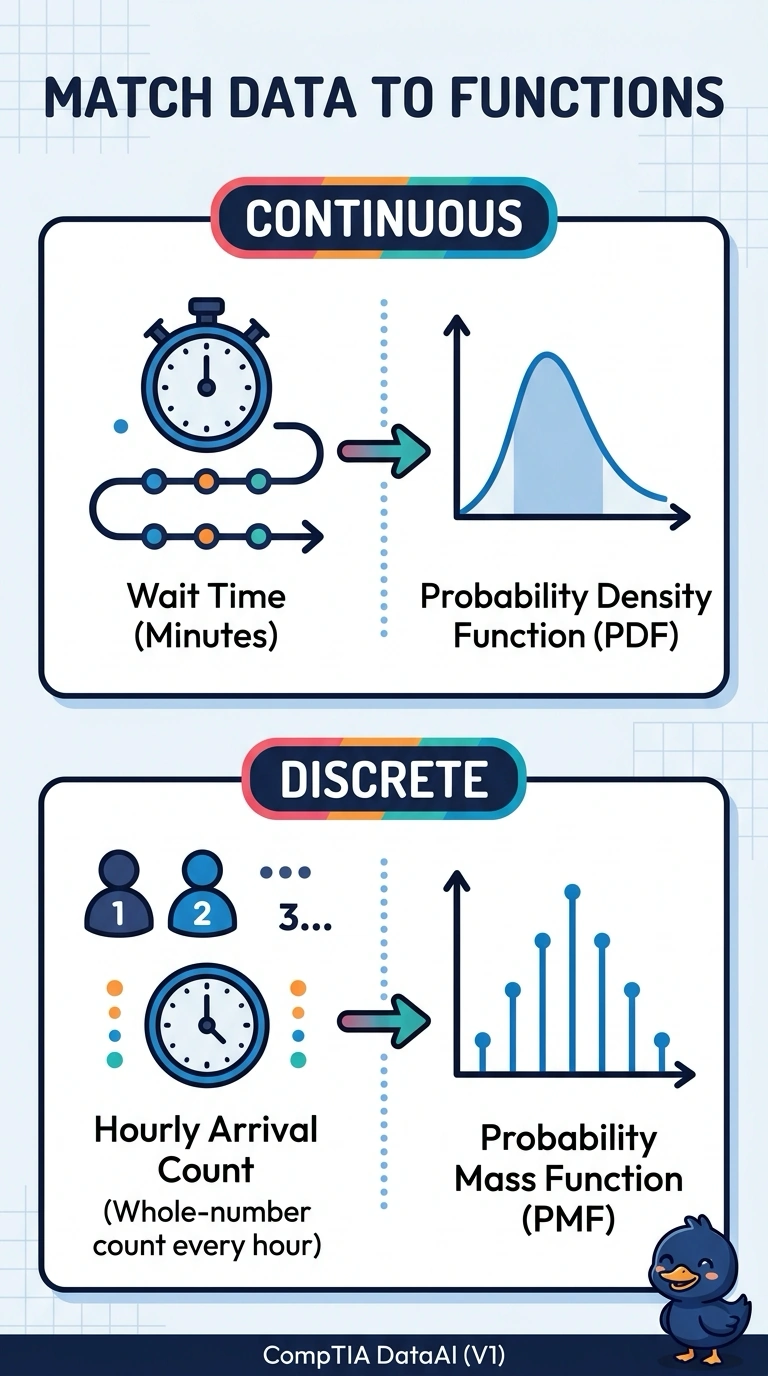
A hospital emergency department records wait time as a continuous number of minutes and records arrivals each hour as a whole-number count. Which functions match those two variables?
Select an answer to reveal the explanation.
Short Explanation
A continuous wait time is a smear of probability, and a head count is a pile of separate integers. You use a density for the smear and a mass function for the pile. Swapping them, or pretending both are piles of points, is the trap.
Full Explanation
A continuous variable such as wait time in minutes is described by a probability density function. Probability is the area under that density over an interval, not the height at a single minute. A discrete variable such as the whole-number count of arrivals in an hour is described by a probability mass function, which assigns probability to each countable value. Pairing the density with wait time and the mass function with the hourly count matches the two measurement scales. Swapping them puts a mass function on a continuous wait time and a density on a count, which reverses the scales. Using one cumulative distribution for both, on the claim that a continuous wait has no density, denies the density that continuous variables do have. A cumulative function answers a different question about probability up to a point. Sharing one mass function across both measurements treats minutes as if they were countable points. Exam caveat: a continuous clock can be stored in whole minutes and still be modeled as continuous when the recording is a fine grid on a duration. Operational check: confirm wait time is handled with intervals or a density, and confirm each arrival count is an integer with probabilities that sum across the possible counts.