
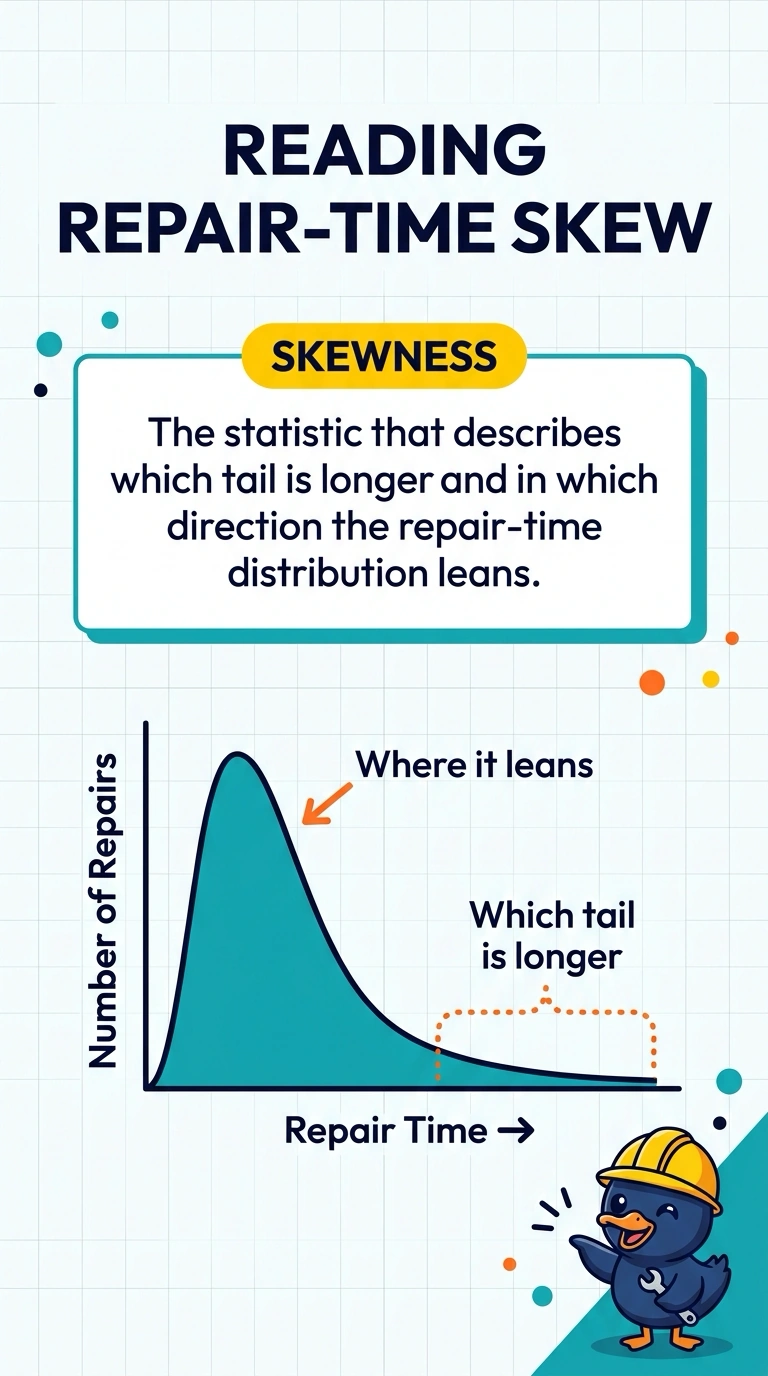
A factory tracks time-to-repair for equipment faults. Most jobs finish quickly, but a long right tail of rare drawn-out repairs pulls the distribution sideways. The team wants the statistic that says which tail is longer. Which description matches?
Select an answer to reveal the explanation.
Short Explanation
A long right tail is like a kite string: most of the mass is close, and one side stretches far away. Skewness is the statistic that tells you which tail is longer, which is the question these repair times are asking. The trap is kurtosis, which talks about how heavy the tails are and not which side sticks out.
Full Explanation
Skewness describes the asymmetry of a distribution: which tail is longer, and in which direction the mass leans. Repair times that pile up at short jobs and stretch into a long right tail are right-skewed, so skewness is the statistic the factory asked for. The mean is pulled toward that long tail, but a single center does not state which side is longer. Kurtosis describes how heavy the tails are relative to a bell shape and does not identify whether the right tail or the left tail is the long one. Variance measures spread around the center and is silent about direction, so a symmetric wide distribution and a lopsided one can share a similar variance. A longer right tail means the high repair times stretch farther than the low side, which is right skew, and that direction is what skewness reports. Spread alone cannot name the side. Exam caveat: a heavy tail and a long tail on one side are different facts; kurtosis can be large in a symmetric distribution, while skewness is what picks the side. Operational check: compute the skewness of time-to-repair and confirm the sign matches the visible right tail, with the long side on the high end of repair time.