
A telecom reliability team draws larger and larger samples of repair times. One analyst says the distribution of the sample mean moves toward a normal bell. Another says the sample mean itself settles toward the population mean of repair time. Which pairing of those claims is correct?
Select an answer to reveal the explanation.
Short Explanation
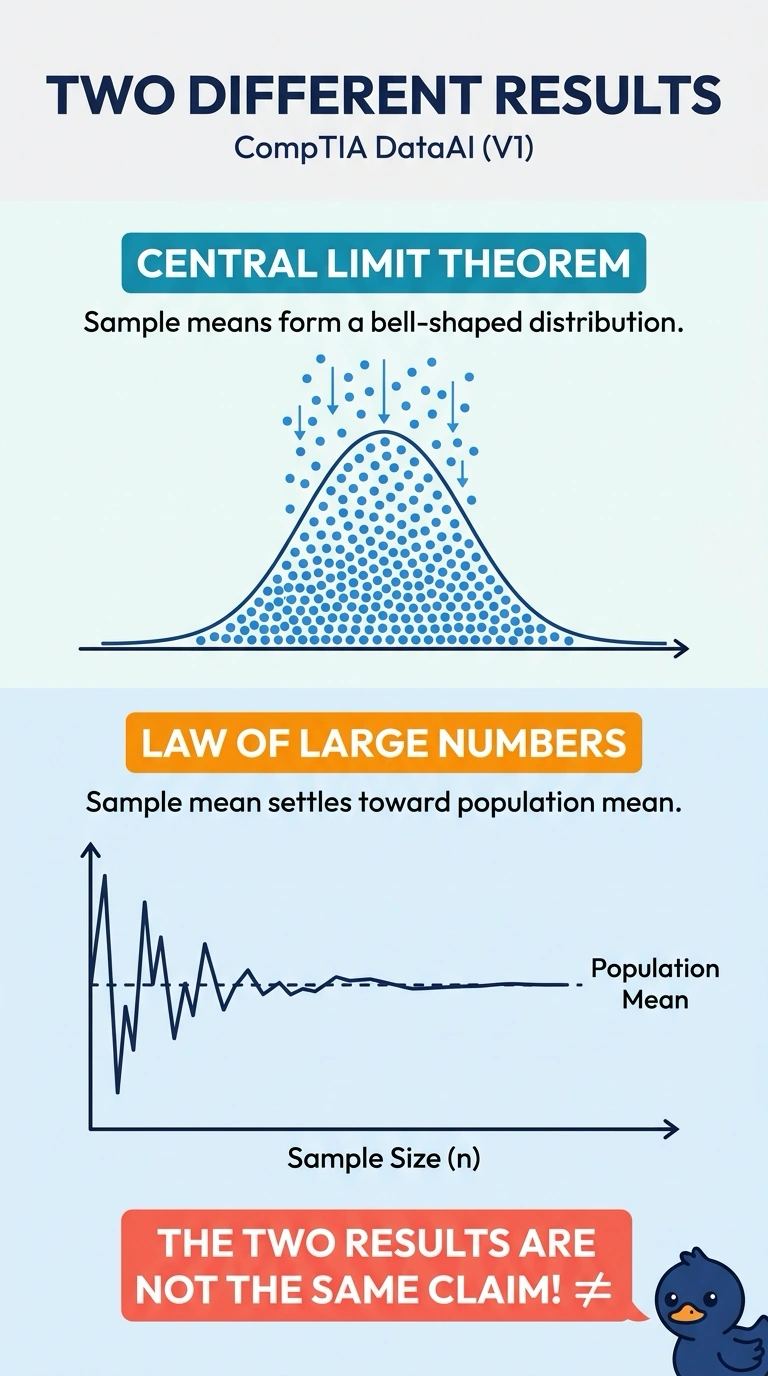
The shape of a pile of averages and the place that pile's center lands are two different promises. As your samples grow, the central limit theorem speaks to the bell shape of the sample-mean distribution, and the law of large numbers speaks to the sample mean settling on the population mean. The trap is swapping those two names, or treating them as one result.
Full Explanation
The central limit theorem concerns the sampling distribution of the sample mean: as the samples of repair times grow, that distribution approaches a normal bell under standard conditions, even when a single repair time is not normal. The law of large numbers concerns the value of the sample mean: it settles toward the population mean as the sample grows. The first analyst is stating the central limit theorem, and the second is stating the law of large numbers. Folding both claims into the law of large numbers drops the result that is about shape. Folding both into the central limit theorem drops the distinction between a bell-shaped sampling distribution and a mean converging to a constant. Swapping the names assigns the bell to the law of large numbers and the convergence of the mean to the central limit theorem, which reverses the two theorems. Exam caveat: neither theorem says the histogram of raw repair times becomes normal; the bell refers to the distribution of the sample mean. Operational check: simulate many sample means at a large sample size, confirm that histogram is roughly bell-shaped, and confirm the average of those means sits near the known population mean.