
A factory quality team scores a defect flag on a counted set of parts: 40 true defect flags, 10 false defect flags, 60 missed defects, and 90 correct passes. Which pair is the precision and the recall of that defect flag?
Select an answer to reveal the explanation.
Short Explanation
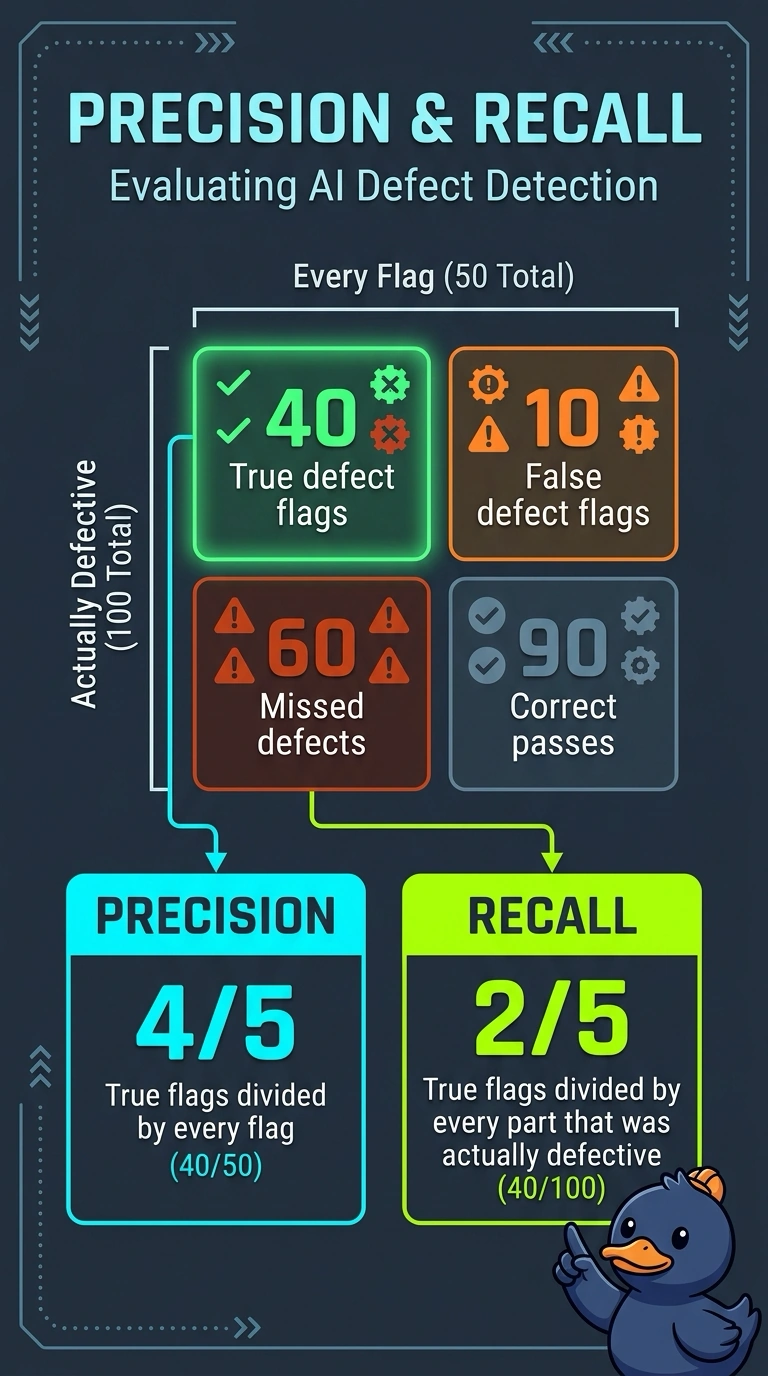
Precision asks how many of the flags you raised were real, and recall asks how many of the real defects you caught. With 40 true flags out of 50 flags, and 40 true flags out of 100 actual defects, you get four in five and two in five. The trap is swapping those two denominators because both counts sit in the same table.
Full Explanation
Precision is the share of defect flags that are truly defects. The flag total is 40 true flags plus 10 false flags, which is 50, and 40 divided by 50 is four in five. Recall is the share of actual defects that were flagged. The defect total is 40 true flags plus 60 missed defects, which is 100, and 40 divided by 100 is two in five. The swapped pair, two in five and four in five, puts the missed-defect count in the precision denominator and the false-flag count in the recall denominator. Thirteen in twenty is accuracy: 40 true flags plus 90 correct passes is 130 correct calls, and 130 divided by 200 parts is thirteen in twenty, which answers how often the call was right rather than how pure the flags were. One in five divides the 40 true flags by all 200 parts, and nine in ten divides the 90 correct passes by the 100 parts that were not actually defective. Exam caveat: precision and recall use different denominators, so a healthy accuracy can sit beside a weak recall. Operational check: add 40 and 10 to get the precision denominator, add 40 and 60 to get the recall denominator, and confirm the pair is four in five and two in five.