
A credit-card bank chose a significance level of 0.05 before examining a test of a new late-fee policy. The test returns a p-value of 0.03. How should the team use those two numbers?
Select an answer to reveal the explanation.
Short Explanation
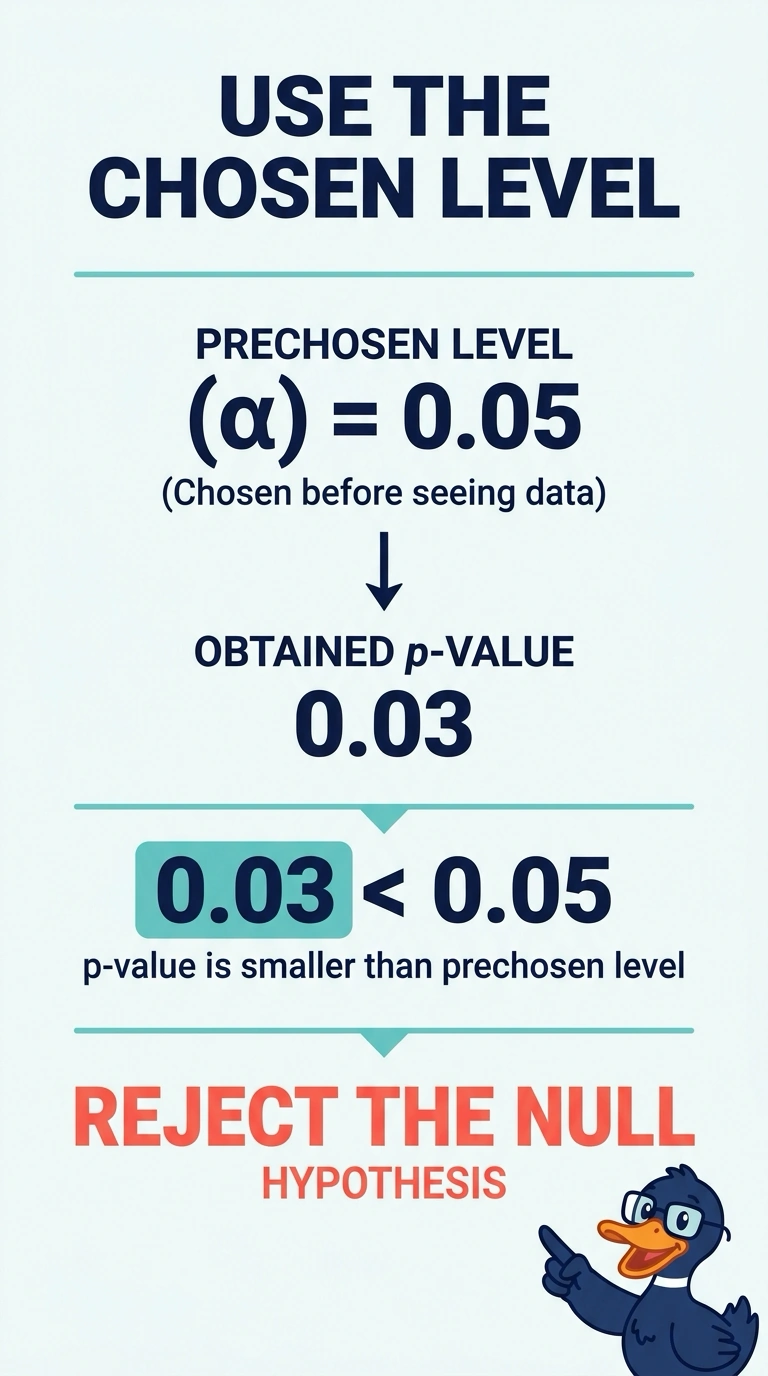
You pick the hurdle before you see the result, then you check whether the p-value cleared the hurdle you already set. The trap is moving that hurdle after a peek, reading the p-value as the probability the null is true, or taking a small p-value as support for no effect. Compare the p-value with the alpha the bank chose in advance.
Full Explanation
The bank committed to a significance level of 0.05 before seeing the test result. The p-value of 0.03 is then compared with that prechosen alpha. Because 0.03 is smaller than 0.05, the result is significant at the level the team chose, and the null hypothesis is rejected at that level. Lowering alpha to 0.01 after seeing 0.03 changes the rule once the outcome is known and no longer uses the alpha chosen in advance. The p-value is not the probability that the null hypothesis is true; it is a statement about how unusual the data would be if the null were true, so reading 0.03 as that probability misuses the number. A small p-value is evidence against the null, not support for accepting a null of no effect, and accepting the null is not the decision that follows from 0.03 falling below 0.05. Exam caveat: 0.05 is the alpha this bank wrote down, not a universal cutoff, and a significant result still says nothing about how large the fee's effect is. Operational check: find the 0.05 level in the analysis plan dated before the p-value was computed, then compare 0.03 with that recorded alpha.