
A precision machine shop predicts the length of a finished part in millimeters and wants an error summary in millimeters that punishes a few large misses more than many tiny ones. Which metric matches that request?
Select an answer to reveal the explanation.
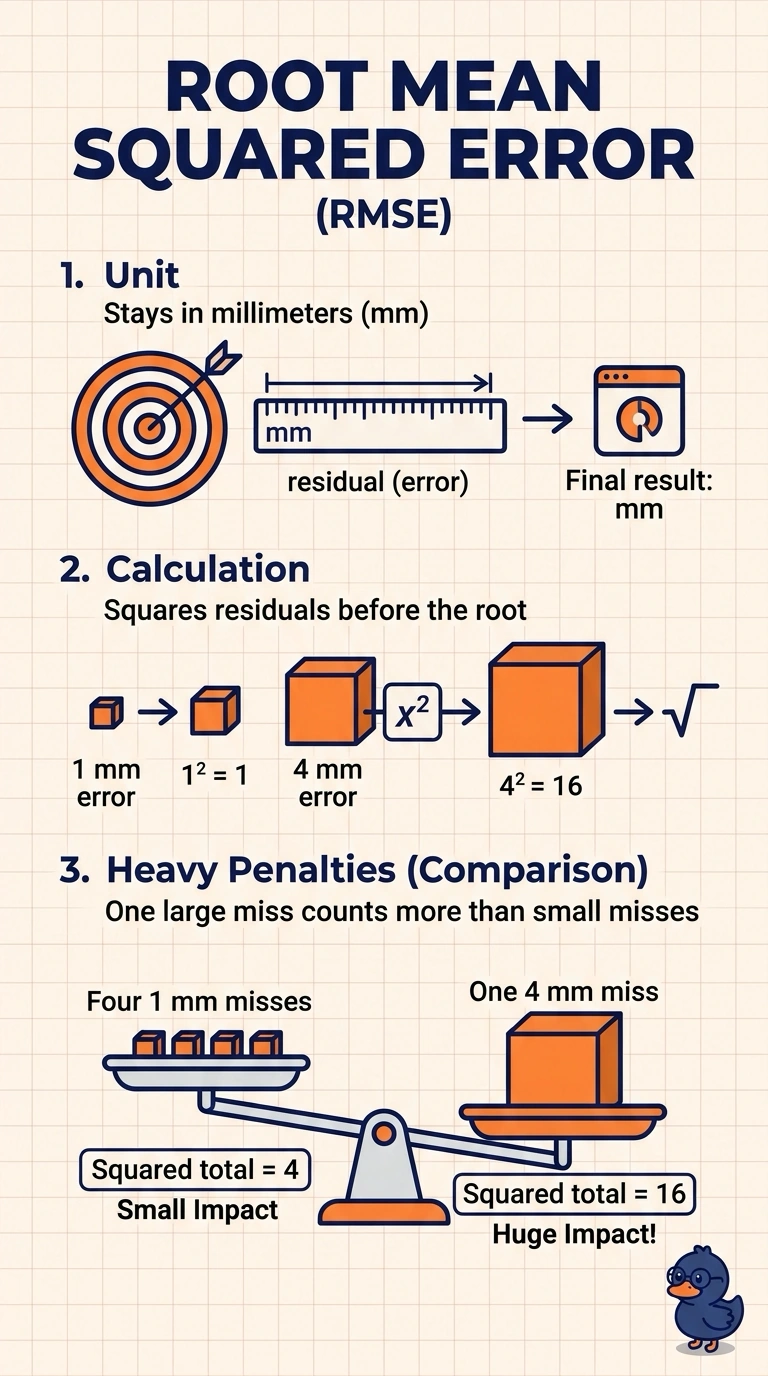
Short Explanation
Root mean squared error speaks in the same units as the length you are predicting, and it squares the misses so one huge error shouts louder than several tiny ones. The trap is a unitless fit score, a right-or-wrong accuracy, or a metric that weights every millimeter the same. You want that squared-then-rooted summary for a big-miss-sensitive error in millimeters.
Full Explanation
Root mean squared error takes the residuals in millimeters, squares them, averages those squares, and then takes the square root. The square root returns the summary to millimeters, the units of part length. Squaring makes a large residual contribute more than its share of absolute size, so a few big misses raise the summary more than many tiny misses that add to the same total absolute error. Mean absolute error also stays in millimeters, but it averages absolute residuals and therefore gives every millimeter the same weight; it does not punish a large miss beyond its absolute size. Classification accuracy counts a prediction as right or wrong and has no millimeter unit, so it cannot describe how far a length was missed. R-squared is a unitless share of variance explained and does not state a typical miss in millimeters. Exam caveat: because the square emphasizes large residuals, one bad measurement can dominate root mean squared error, so the metric is doing what was asked and is not a resistant summary of a typical miss. Operational check: compute both root mean squared error and mean absolute error on the same millimeter residuals and confirm the squared version reacts more when a large miss is included.