
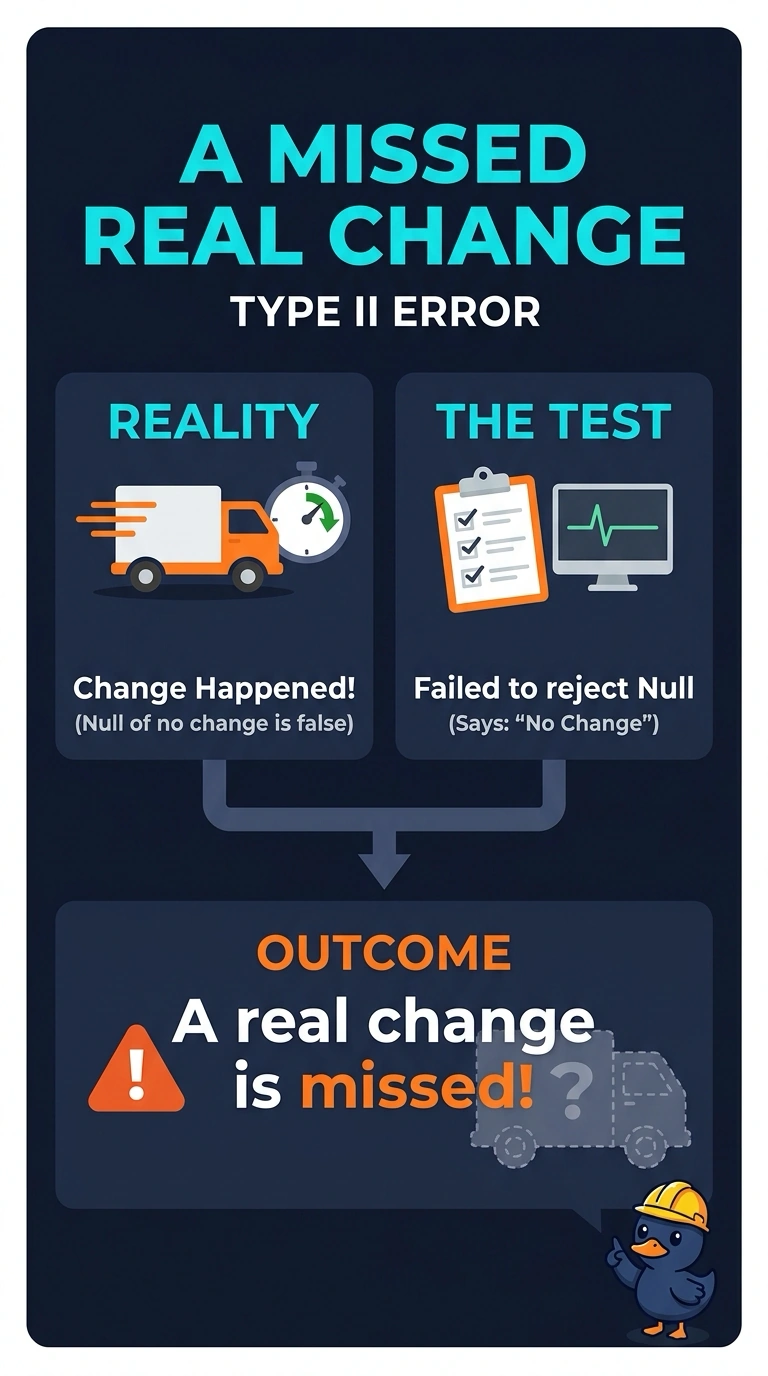
A logistics desk tests whether a new dock layout changes average truck turn time. The layout truly does change turn time, but the test fails to reject the null hypothesis of no change. What error has the test made?
Select an answer to reveal the explanation.
Short Explanation
Walking past a real fork in the road is a different mistake from shouting about a fork that is not there. You failed to reject a null that the new dock layout had already made false, and that miss is a Type II error. The trap is treating a non-rejection as proof that the layout changed nothing.
Full Explanation
A Type II error is a failure to reject a null hypothesis that is false. Here the null says the dock layout does not change average turn time, and the scenario states that the layout truly does change turn time, so the null is false. The test nevertheless fails to reject it. That combination is a Type II error, sometimes described as a missed detection. A Type I error is the opposite mistake: rejecting a null that is true. This test did not reject the null, and the null is not true, so the false-alarm label does not fit. Keeping the null is not a correct discovery that the layout did nothing. Failure to reject is a statement about the test result, not proof that the effect is absent, and in this scenario the effect is present. Statistical power is the probability of rejecting a false null, not the name of the mistake. Low power makes a Type II error more likely, but power itself is not the error the desk committed. Exam caveat: in day-to-day work the true effect is unknown, so a nonsignificant test is reported as a failure to reject, not as a proven Type II error and not as acceptance of the null. Operational check: write the decision as a failure to reject the null of no change, and place the estimated turn-time difference beside it so a quiet test is not narrated as proof of no effect.