
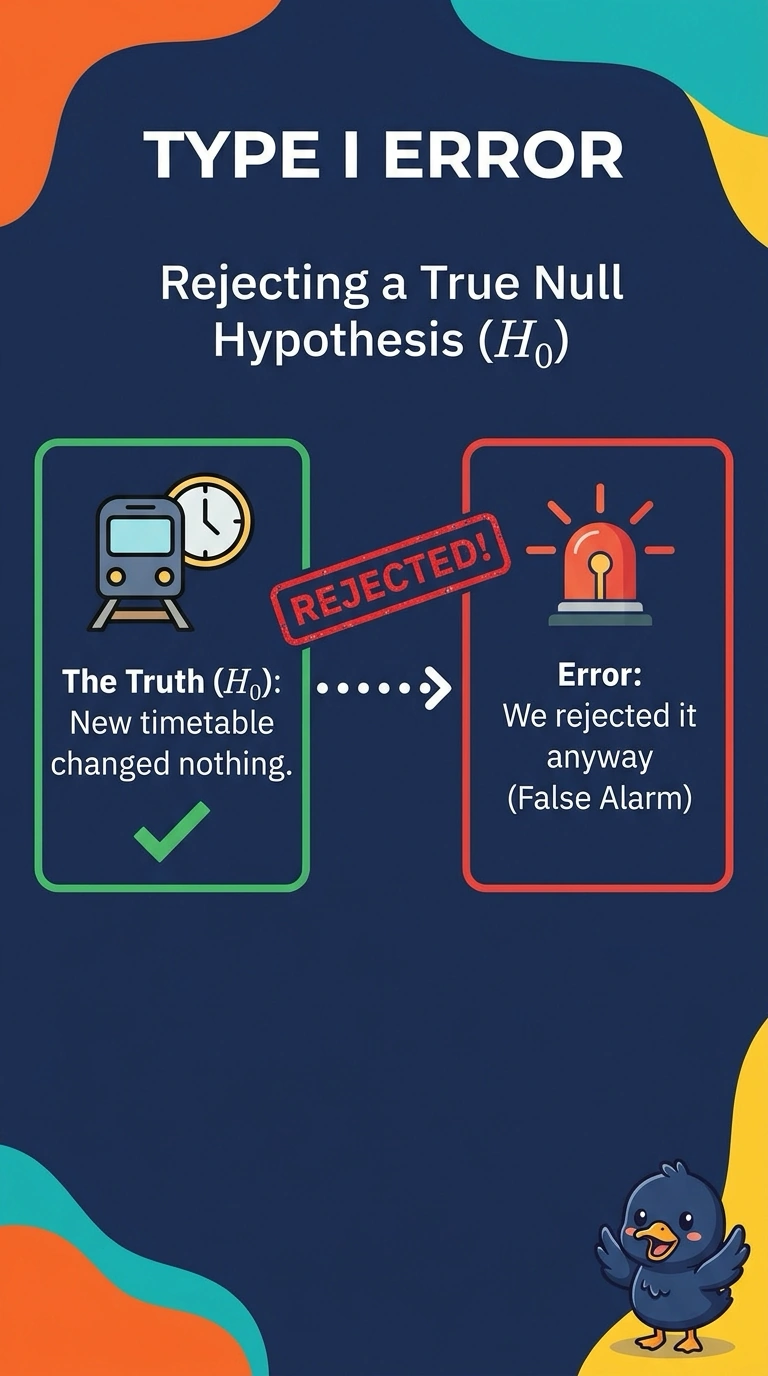
A transit agency tests whether a new timetable changes the share of buses that arrive on time. The null hypothesis says the share is unchanged. Analysts reject that null even though the timetable truly changed nothing. Which error did they make?
Select an answer to reveal the explanation.
Short Explanation
Rejecting a null that is actually true is a false alarm, like clearing a building when the bell rings and there is no fire. The trap is calling that a missed real effect, a correct decision to keep the null, or a biased sample of routes. You rejected a true null, so the error in front of you is that false alarm.
Full Explanation
A Type I error is rejecting a null hypothesis that is true. The null says the on-time share is unchanged, the timetable truly changed nothing so that null is true, and the analysts rejected it. Those two facts are the definition of a Type I error. A Type II error is the opposite decision: failing to reject a null that is actually false, which would miss a real change. Here the null is true and the analysts rejected it, so the error is not Type II. Keeping the null would have been the decision that matches a true null, but the analysts did not keep it; they rejected it, so the outcome is not a correct retention. Sampling bias would mean the routes were chosen in a way that distorts the comparison. Nothing in the scenario says which buses were selected; the stated result is a rejection of a true null, and that result is a Type I error even when the sample itself was drawn fairly. Exam caveat: a Type I error is the false rejection that a prechosen significance level limits in the long run, and it is not evidence that the sample must have been biased. Operational check: write down the null, note that it is true in this scenario, note that the analysts rejected it, and classify that pair as a Type I error.