
A media studio compares two forecasting models on a large sample of weekly view counts. The richer model adds several parameters and fits past weeks more closely. The studio wants the criterion that charges more per extra parameter at this large sample size. Which comparison is right?
Select an answer to reveal the explanation.
Short Explanation
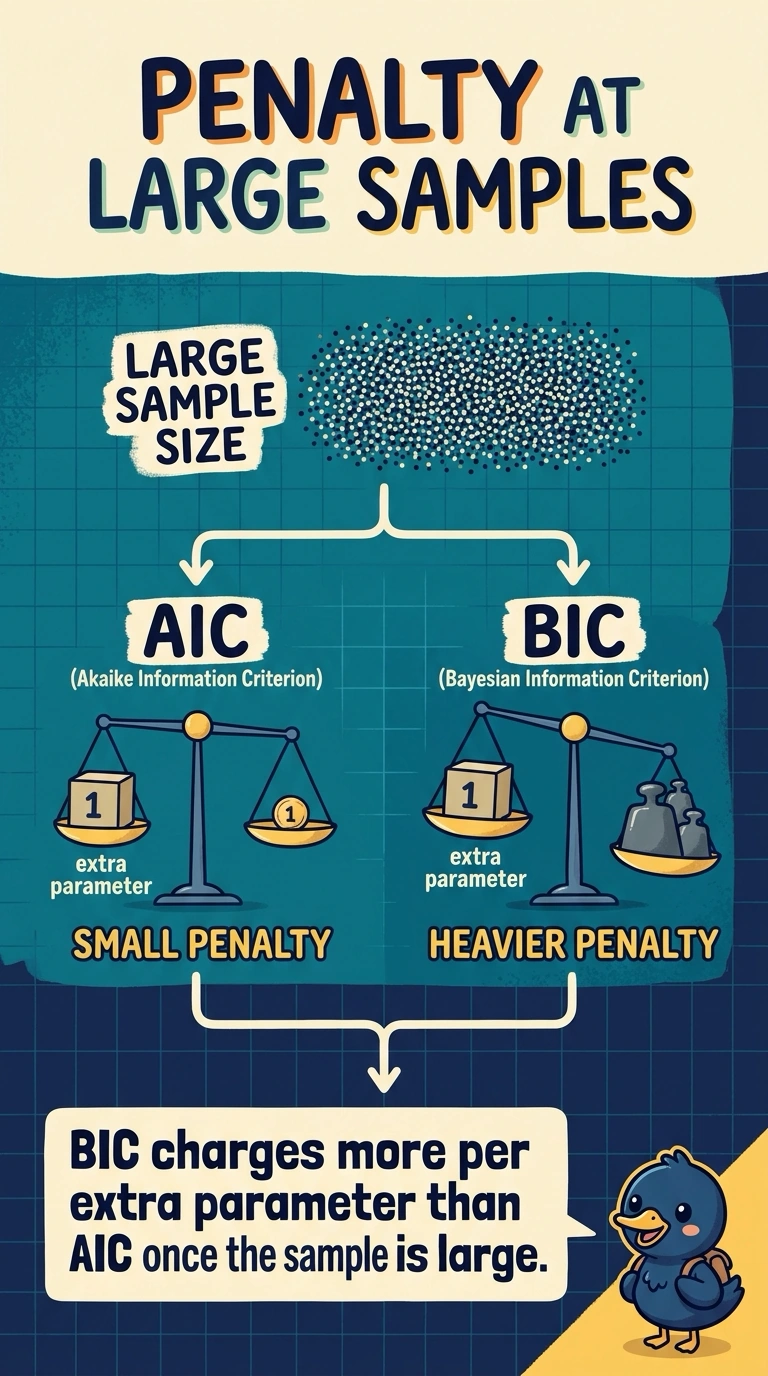
A larger hall can raise the cover as the crowd grows, while a small club keeps the same cover. You are on a large sample, where the Bayesian information criterion charges more per extra parameter than the Akaike criterion. The trap is swapping those two penalties or treating them as the same at every sample size.
Full Explanation
Both criteria start from a fit statistic, commonly minus twice the log likelihood, and then add a penalty that grows with the number of parameters. The Akaike information criterion adds two times the parameter count. The Bayesian information criterion adds the natural log of the sample size times the parameter count. The charge per extra parameter is therefore fixed at two under the Akaike criterion and equal to the log of the sample size under the Bayesian criterion. Once that log exceeds two, which is the large-sample situation the studio is in, each extra parameter costs more under the Bayesian criterion. The richer model is penalized more heavily there than under the Akaike criterion, even though it fits past weeks more closely. Swapping the names reverses the formulas. Treating the penalties as identical at every sample size ignores that one of them grows with the log of the sample size. Saying the Bayesian criterion ignores the parameter count is also wrong: the parameter count is multiplied by the log of the sample size, so extra parameters are not free. Exam caveat: on a very small sample the log of the sample size can be less than two, so the heavier Bayesian charge is not a claim about every sample size. Operational check: compute both penalties from the same parameter count and the same sample size, and confirm the Bayesian penalty is the larger one before you describe it as the stricter charge.