
An agency compares mean on-time minutes across four separate bus depots. On-time minutes are continuous, and the depots are independent groups. Which test fits that comparison of means?
Select an answer to reveal the explanation.
Short Explanation
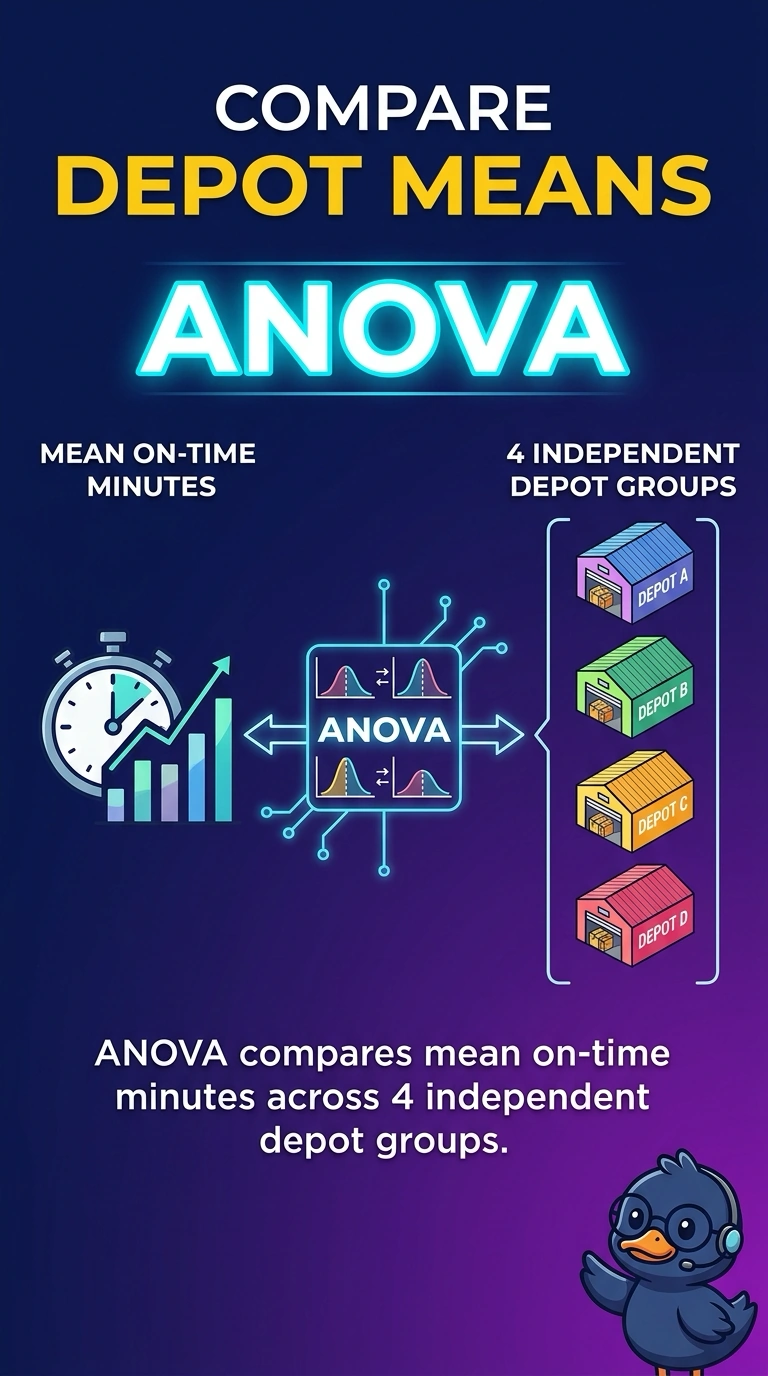
With four independent depot groups, you need a test that compares all four means in one analysis. ANOVA fits continuous on-time minutes; a chi-square test needs categories, a two-sample t-test is for two groups, and a paired test needs matched buses.
Full Explanation
ANOVA compares the means of a continuous outcome across three or more independent groups in one test. On-time minutes are continuous, the four depots are separate groups, and you want to know whether their means differ, so ANOVA is the matching procedure. A chi-square test of association between depot name and a late-versus-on-time label requires categorical factors; it does not compare mean minutes. A two-sample t-test is built to compare means for two groups, so it is not the test for comparing all four depots in one analysis. A paired test requires matched units, such as the same bus measured in a linked way, and separate depots do not supply those pairs. Exam caveat: a significant ANOVA means the four depot means are not all equal; it does not by itself identify which depot differs from which. Practical check: confirm the outcome is on-time minutes, each observation belongs to one of the four depots, and the analysis is a four-group ANOVA before you brief the finding.