
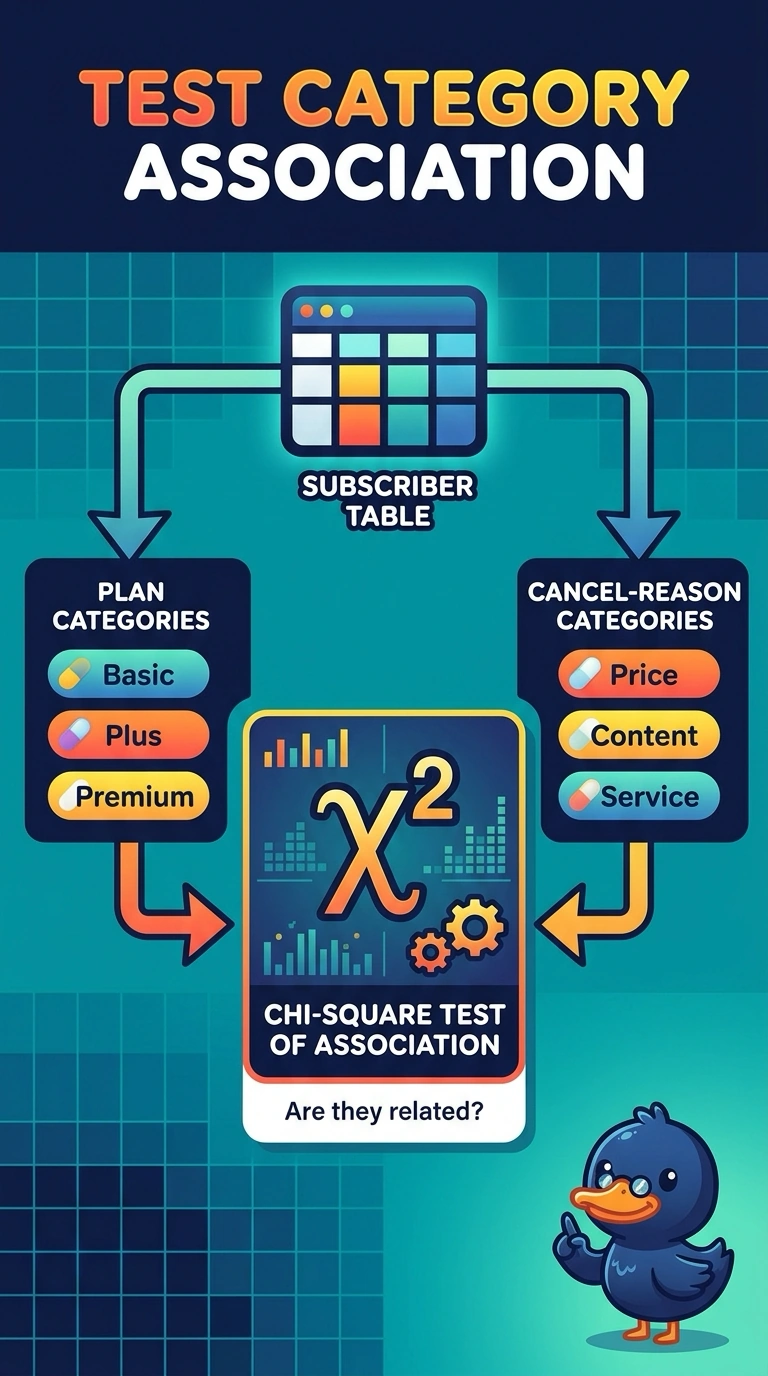
A media company wants to test whether subscription plan, recorded as basic, plus, or premium, is associated with cancel reason, recorded as price, content, or service. Which test fits those two categorical factors?
Select an answer to reveal the explanation.
Short Explanation
When both factors are labels, you count how the combinations stack up instead of averaging a number that is not there. A chi-square test of association fits plan against cancel reason. A t-test, a correlation of the names, or an ANOVA of tenure answers a different question.
Full Explanation
A chi-square test of association compares the counts in a table of two categorical factors with the counts you would expect if the factors were unrelated. Subscription plan and cancel reason are both categories, and the question is whether they are associated, so the chi-square test matches the data and the claim. A two-sample t-test compares means of a numeric measurement between two groups; it does not test a link between plan labels and reason labels. A correlation computed on the category names treats arbitrary labels as paired scores, which those names are not. An ANOVA of mean tenure across plans compares a numeric outcome among plans and, as described, never uses the cancel-reason factor, so it cannot answer the association question. Exam caveat: a significant chi-square result supports association, not a claim that one plan causes a cancel reason. Operational check: build the plan-by-reason count table and confirm both fields are categories before the chi-square test is run, with no numeric code assigned to the labels just to force a correlation.