
A factory tests whether two production lines have the same mean defect rate. The result fails to reject the null at the alpha the team chose before seeing the data. Which reading is sound?
Select an answer to reveal the explanation.
Short Explanation
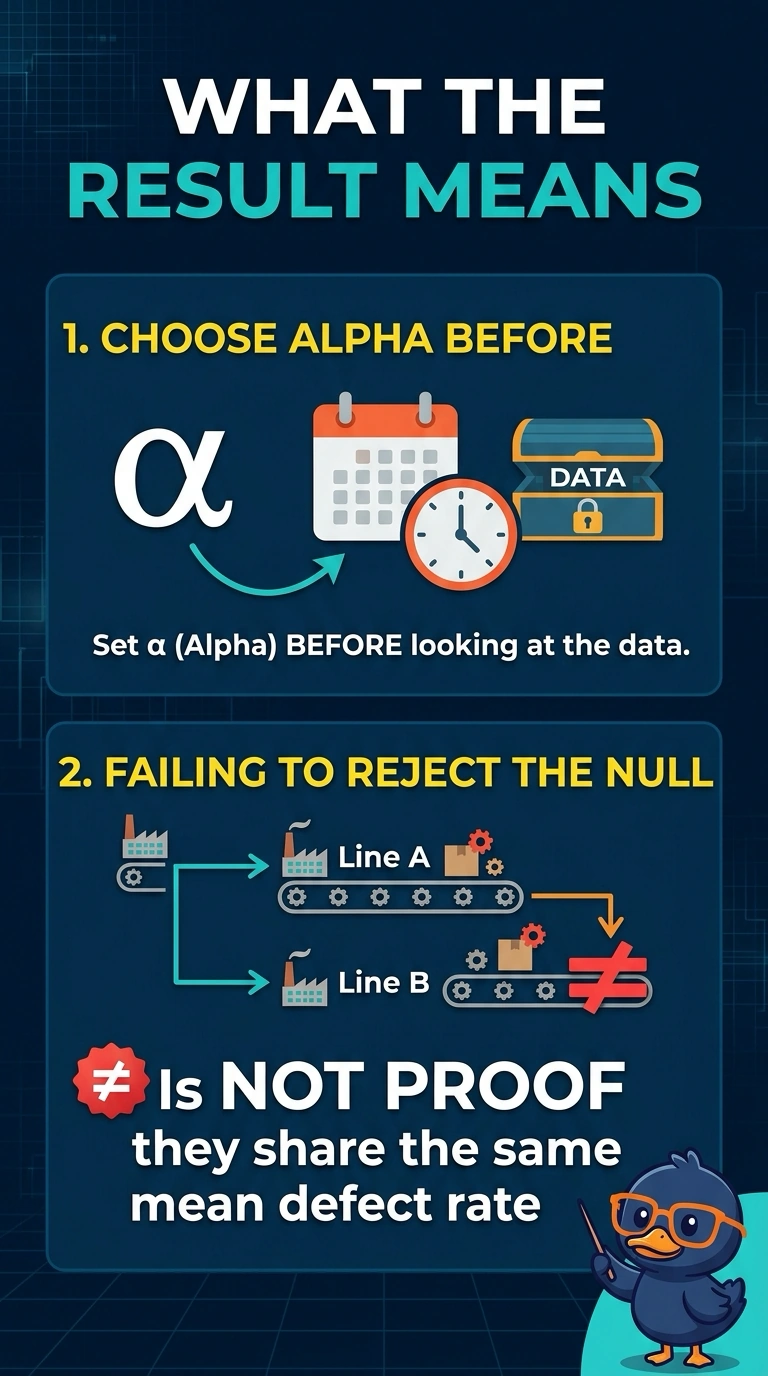
You can treat a failure to reject as a non-rejection, not a trophy for the null. It does not prove the two lines have the same mean defect rate. Nor does it show that the first line is better, or that sharing a factory means you should reject the null.
Full Explanation
A hypothesis test either rejects the null or fails to reject it. Here, at the alpha chosen before the data were seen, the result was not strong enough to discard the null of equal mean defect rates. That is not proof that the null is true or that the lines share the same mean; a real difference may remain hidden in noisy data or a modest sample. Saying the test accepted the null and proved equality overstates what a non-rejection demonstrates. A two-sided test asks whether the means differ in either direction, so failing to reject it does not show that the first line is better than the second. The fact that both lines are in the same factory is not a statistical result and gives no reason to switch the conclusion to a rejection. Exam caveat: keep the alpha the team chose beforehand; changing it after seeing the result to force a rejection changes the test. Practical check: record that prechosen alpha, the non-rejection, and the sample sizes, and report a failure to detect a difference rather than proof that the means are equal.