
A telecom desk receives a new cell-site reading that has no label yet. Historical readings close to it in feature space are already marked either as an alarm or as normal operation. Which rule should assign the new reading's label?
Select an answer to reveal the explanation.
Short Explanation
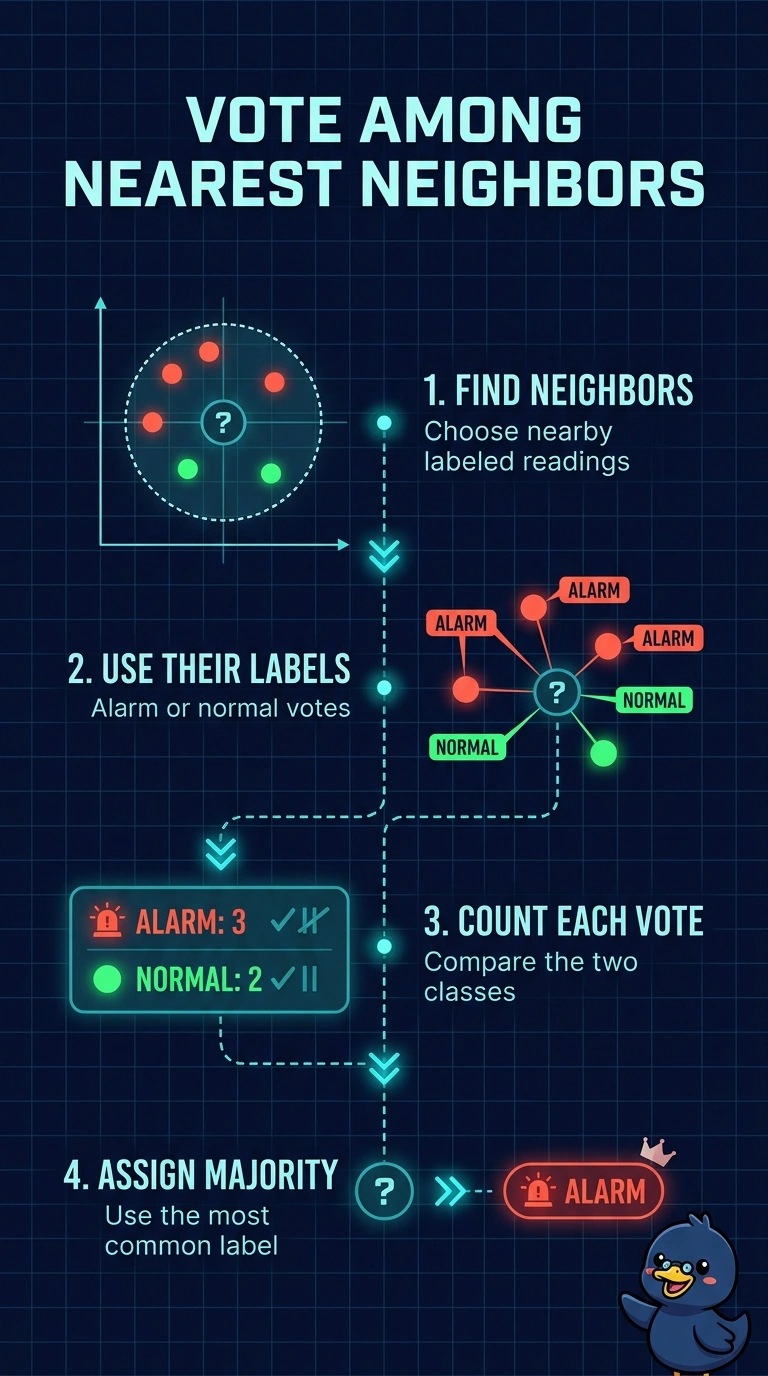
Ask the people standing nearest the newcomer and let their majority decide. You label the new reading from the majority class among its nearest labeled neighbors. The trap is copying the point on the far side of the room, or throwing the labels away for a density trick.
Full Explanation
The new reading has no label, and historical readings near it in feature space already carry alarm or normal labels. The matching rule takes the majority class among the nearest of those labeled neighbors, which is nearest-neighbor classification: proximity plus the labels already in hand. Projecting onto an axis of greatest variance and cutting that axis ignores those neighbor labels and substitutes a different summary of spread. Marking the reading as noise applies an unlabeled density rule that sets sparse points aside; the task here is to assign alarm or normal, and the nearby history is already labeled. Copying the farthest reading inverts the neighbor rule and trusts the least similar history instead of the closest. Exam caveat: the vote is only as meaningful as the distance, and features on incompatible scales can make the wrong readings look near. Operational check: for a held-out reading, list the neighbors that entered the vote and confirm the assigned label is the majority class among those neighbors.