
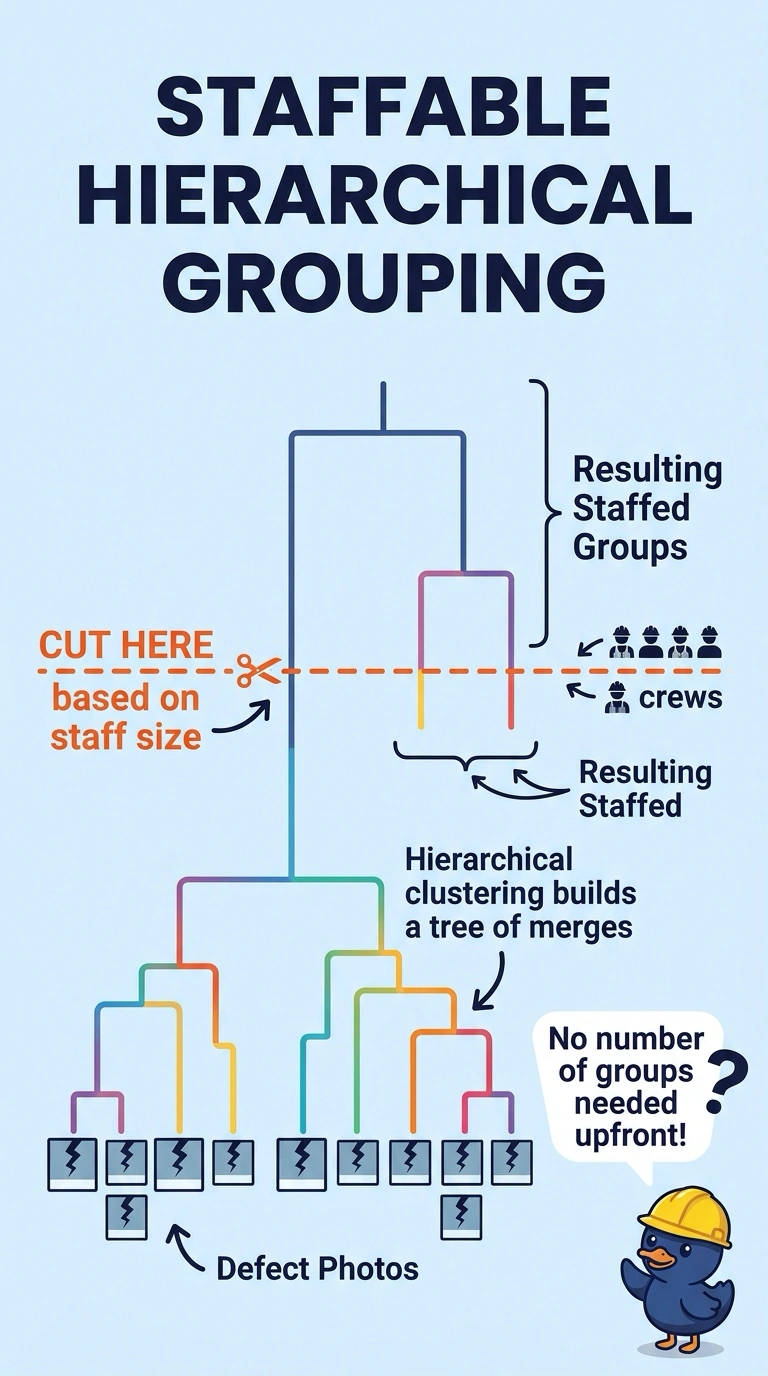
A factory engineer wants to group defect photos without choosing how many groups to use at the start, then cut that grouping at a level the crews can staff. Which method fits this plan?
Select an answer to reveal the explanation.
Short Explanation
A family tree does not ask you to declare the number of branches before anyone is related. You use hierarchical clustering so the defect photos merge into a tree you can cut later. k-means wants the group count before it starts, so it does not fit this plan.
Full Explanation
Hierarchical clustering merges groups step by step into a tree and does not require the number of groups at the start. The engineer can build that tree from the defect photos and later cut it at a level the crews can staff, which matches both parts of the plan. The tree keeps every merge, from individual photos up to one group, and a cut across it is what yields the staffed groups. k-means requires the group count before assignment, so it cannot wait until a staffing cut to learn how many groups exist. Density clustering can avoid a preset group count by using a neighborhood radius, and it may mark sparse photos as noise, but it does not produce a merge tree to cut at a staffed level. A silhouette summary scores a grouping that already exists and does not build the groups. Exam caveat: the linkage used when merging changes which photos join, so the cut level is not unique just because a tree was built. Operational check: record the linkage and the cut the crews will staff, and confirm the group count was not required before the tree existed.