
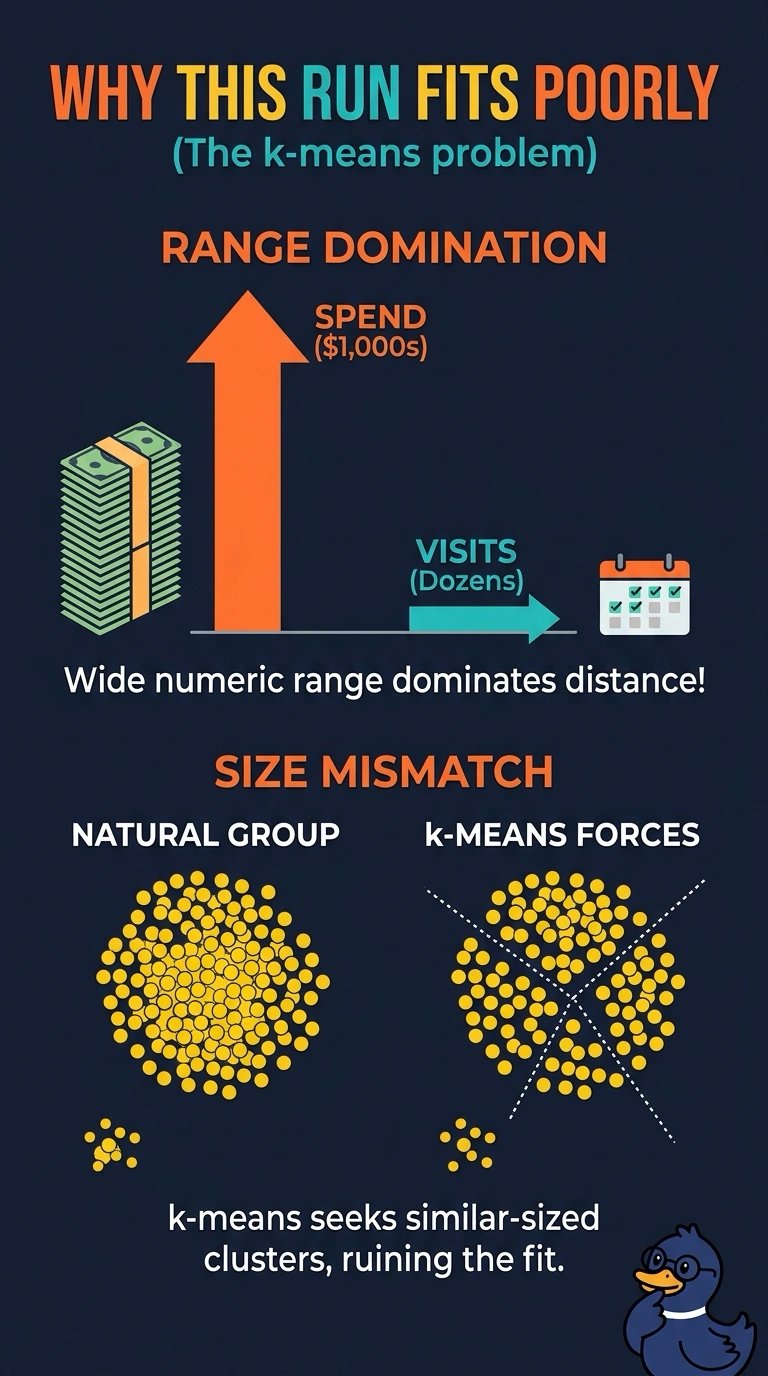
A grocery chain runs k-means on shoppers using annual spend in dollars and visits per month. Spend ranges in the thousands while visits stay in the dozens, and one spender group dwarfs the others. Which limitation of k-means fits this run?
Select an answer to reveal the explanation.
Short Explanation
An unadjusted scale will notice the elephants and miss the mice standing beside them. You should expect k-means to let dollar spend swamp visits per month and to struggle when one shopper group dwarfs the rest. The trap is believing the method is indifferent to units or to cluster size.
Full Explanation
k-means assigns points by Euclidean distance to centroids and tends toward compact clusters of similar size. Annual spend in the thousands and visits in the dozens means the spend coordinate dominates that distance unless the features are put on a common scale, so visit frequency barely moves the grouping. A spender group that dwarfs the others also fights the similar-size tendency, which can split the large group or absorb a small one. The claim that k-means is invariant to units is the opposite of this scale problem, because multiplying spend by a change of currency would rewrite the distances. A neighborhood radius that marks thin regions as noise is a density method, not k-means, which assigns every shopper to a centroid. A full merge tree whose cut is chosen afterward is hierarchical clustering, and k-means needs the group count as an input rather than building that tree. Exam caveat: standardizing the two features addresses the unit mismatch and still leaves unequal or non-round groups hard for k-means. Operational check: standardize spend and visits, rerun k-means, and compare the groups with the unscaled run to see how much the dollar range was driving the split.