
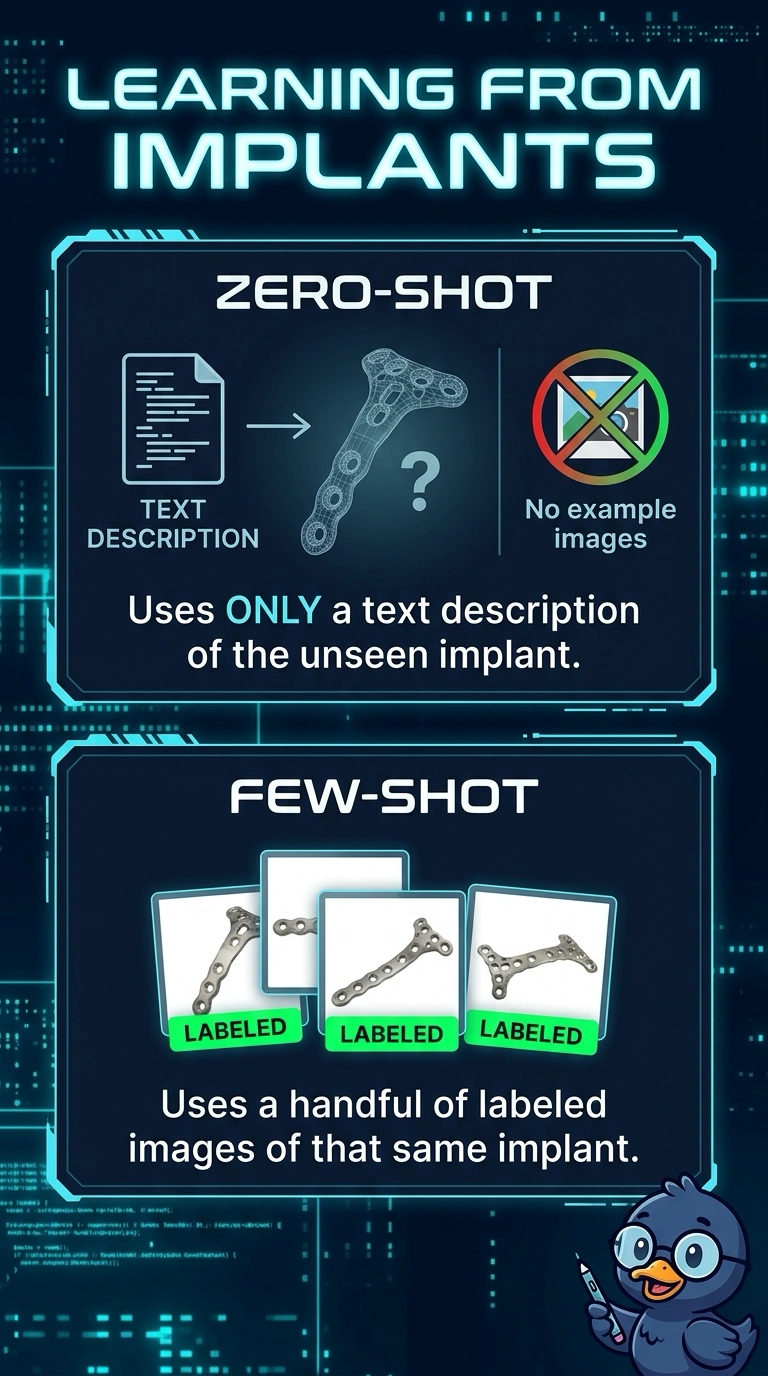
A hospital imaging team must handle a rare implant the model has never seen. They can describe that implant in text with no example images, or they can supply a handful of labeled images of it. Which pairing of those two setups is correct?
Select an answer to reveal the explanation.
Short Explanation
A wanted poster with a description is a different tool than a few labeled snapshots. You are in zero-shot learning when the implant is only described, and in few-shot learning when you have a handful of labeled images. Do not swap those two setups.
Full Explanation
Zero-shot learning names a class the model has not been shown by using a description of that class, here a text account of the implant and no example images. Few-shot learning instead uses a small number of labeled images of that same implant so the model can align the new class with those examples. The two setups differ in what is supplied for the unseen class: words alone, or a handful of labeled pictures. Swapping the names assigns the images to zero-shot and the description to few-shot, which reverses the definitions. Requiring a large labeled library of the rare implant before either setup can work denies the point of both methods, which exist for the case where that library is missing. Ignoring the labels and clustering photos, or retraining on implants the hospital already knows, does not use the description or the handful of new labels the team actually has. Exam caveat: a handful means a few labeled examples, not a full training corpus and not zero examples. Operational check: record whether the rare-implant run received only the text description or a small labeled image set, and name the run to match that input.