
A utility forecasts hourly load from a long stretch of meter readings. A plain recurrent net updates one hidden state each hour and has lost the early months by the time winter arrives. Which design keeps a gated memory across that long sequence?
Select an answer to reveal the explanation.
Short Explanation
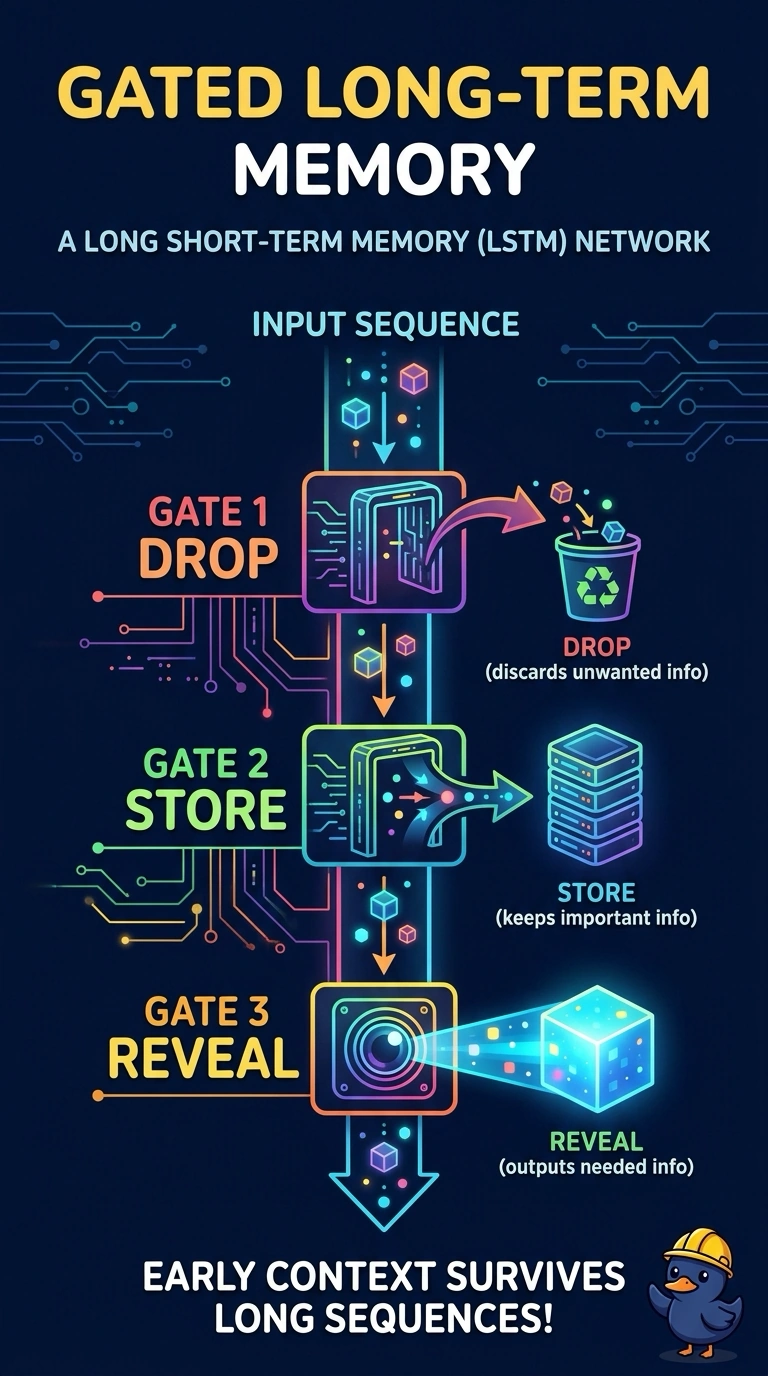
A plain recurrent net is a whiteboard erased and rewritten every hour, so spring is gone by winter. You want a long short-term memory network whose gates keep a memory across that long meter history. The trap is hoping a bigger hidden state, with no gates, will hold the early months.
Full Explanation
A plain recurrent step folds the entire past into one hidden vector and then overwrites it, so a signal from early months is easily washed out before winter. A long short-term memory network adds gates around a cell state: a forget gate can keep prior context, an input gate can write new meter information, and an output gate can control what the hour's prediction sees. That gated cell is why a long sequence is easier than with the plain recurrent update. Widening the plain hidden state still leaves a single overwrite each hour and does not create a gate that protects earlier context. A convolutional stack over neighboring hours looks at a short local window and has no cell that carries a gated memory across months. Averaging the history into one bag destroys order, so there is nothing left to remember through time. Exam caveat: gates ease vanishing memory; they do not by themselves fix a meter series whose regime has changed. Operational check: confirm the cell update uses forget, input, and output gates rather than a single squash of one hidden vector.