
A retail chat assistant reads a long return-policy thread. A recurrent model walks that thread one token at a time and slows as the thread grows. The team switches to a design that relates each token to the others in one pass. Which design is that?
Select an answer to reveal the explanation.
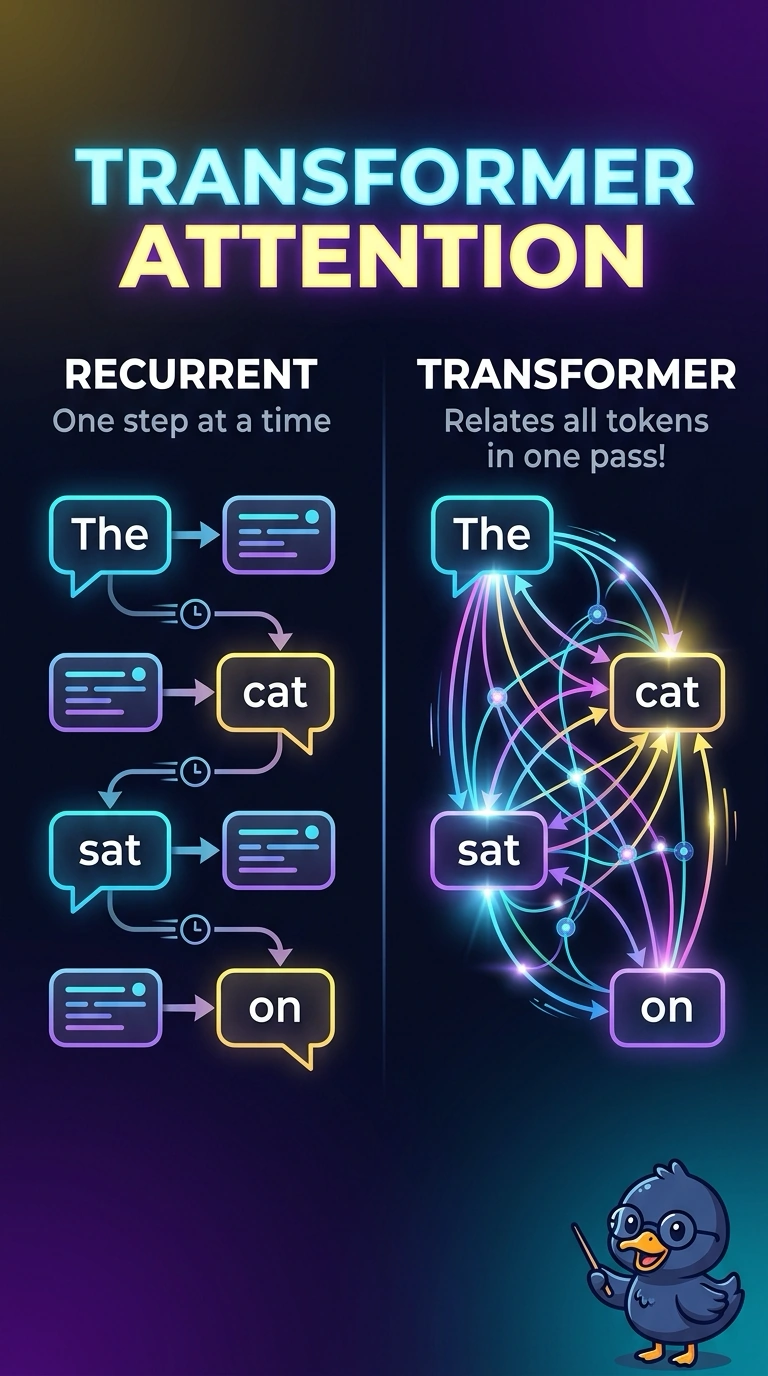
Short Explanation
Attention is a glance across the whole thread, not a walk one word at a time with a fading notepad. You want a transformer, which relates tokens through attention instead of stepping through the thread in time order. The trap is keeping a recurrent net and hoping a longer thread will not slow the reply.
Full Explanation
The recurrent model advances one token at a time because each step waits on the previous hidden state, so a longer return-policy thread means a longer chain of steps. A transformer replaces that march with attention: each token is scored against the others in the thread in one pass, and no hidden state has to be carried forward one time unit at a time. That is the design the team switched to. A plain recurrent net is the behavior they are leaving, because it still updates one hidden state after every token and still walks the thread in order. A convolutional filter with a small window only sees neighboring tokens, so distant sentences in the policy thread never meet inside that filter. A bag of words throws away which token is which and cannot score a relationship between two particular tokens. Exam caveat: attention can be masked so some tokens are hidden from each other; it still is not a recurrent state updated one step at a time. Operational check: confirm the layer computes attention weights over token positions rather than a recurrent state that advances one token per step.