
A hospital teaching lab wants synthetic chest films. One network proposes images and a second network judges whether each image looks real or fake, and the two train against each other. Which architecture is this?
Select an answer to reveal the explanation.
Short Explanation
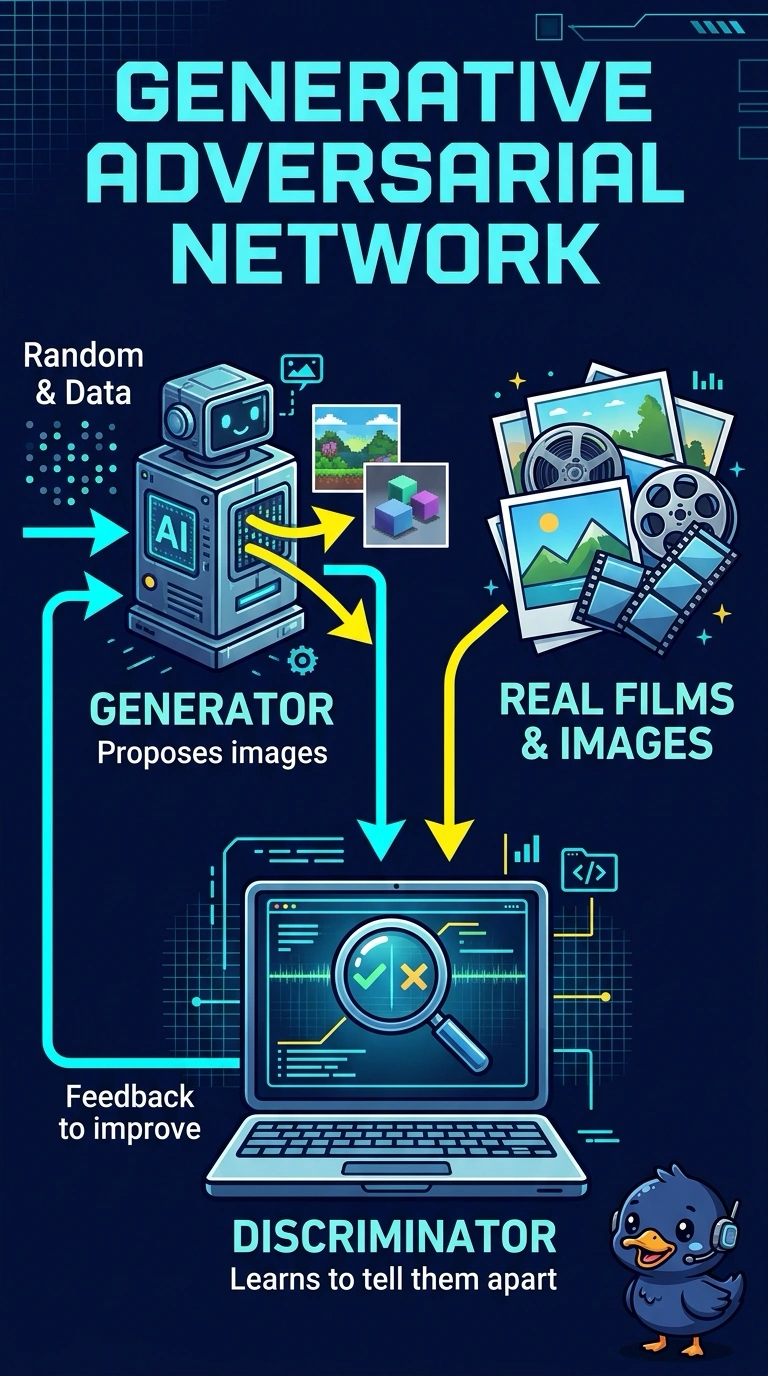
Picture a forger and a detective drilling in the same room, each improving because of the other. You are looking at a generative adversarial network: one network proposes images and the other judges them. The trap is calling it an autoencoder, which rebuilds a real film and has no opponent.
Full Explanation
The lab has two networks in opposition. The generator proposes chest films, and the discriminator scores whether a film is a proposal or a real teaching image. Each update depends on the other: the generator improves by making the discriminator's job harder, and the discriminator improves by catching the proposals. That opposed pair is a generative adversarial network. An autoencoder compresses a real film and rebuilds it; its target is reconstruction of a given input, and nothing in that loop judges real versus fake. A convolutional classifier assigns labels to real films and does not train a second network to invent images. A variational autoencoder also samples images from a latent code, but its training matches a reconstruction term and a prior on the code, not a discriminator that is learning to reject fakes. Exam caveat: the discriminator's own accuracy is not the success criterion; the point of the pair is the generator's films. Operational check: confirm each training step updates a generator against a discriminator that sees both real films and the generator's current proposals.