
A media captioning model keeps lowering its training loss, but validation loss has risen for several checks in a row. The team wants training to halt when validation loss stops improving. Which practice is that?
Select an answer to reveal the explanation.
Short Explanation
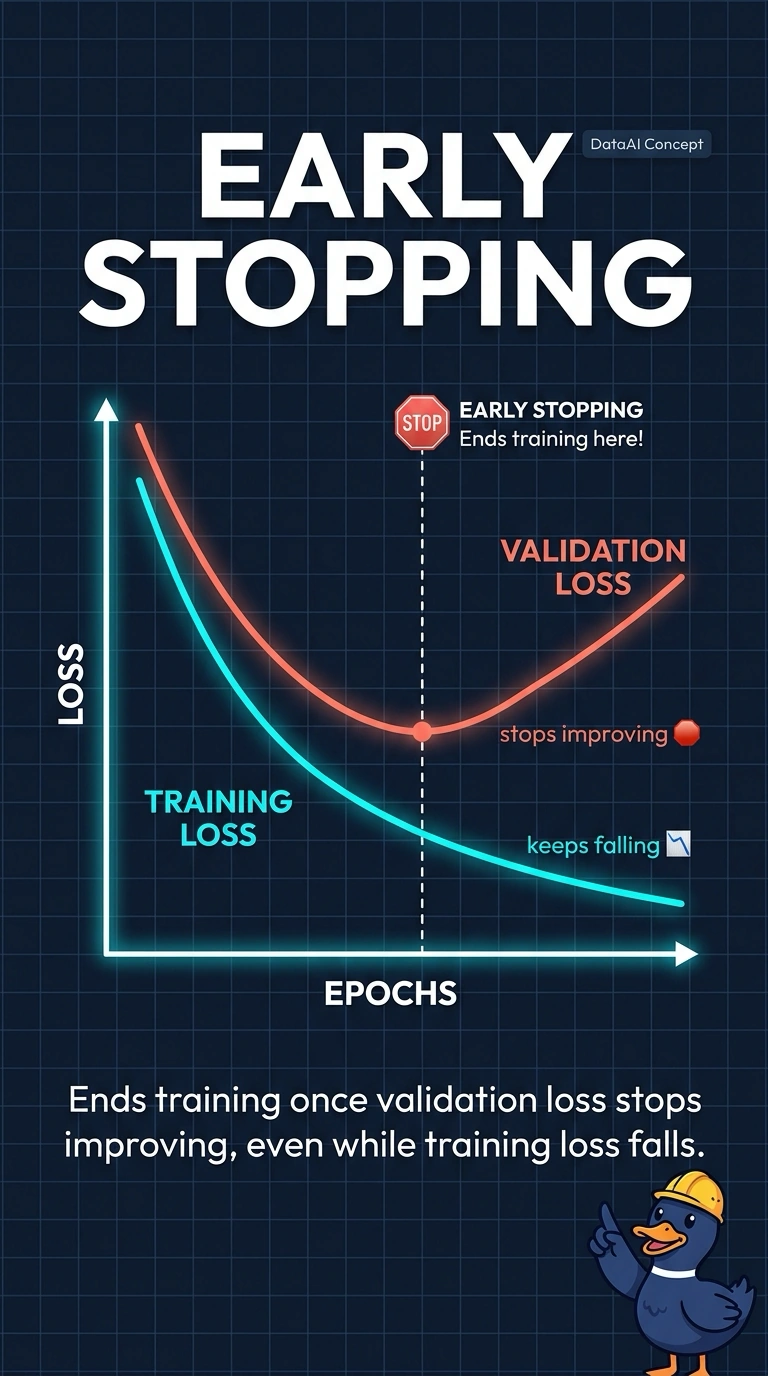
Leave the gym when your check-set form gets worse, not when practice still feels busy. Early stopping halts training once validation loss stops improving, even if training loss is still falling. The trap is training longer just to chase the training number.
Full Explanation
Early stopping monitors a validation loss that the training updates do not directly optimize, and it halts when that loss stops improving. The captioning model is already in that state: training loss is still falling while validation loss has risen for several checks, which is the usual sign that further passes are fitting the training captions rather than generalizing. Dropout randomly masks units and never consults validation loss to decide when to stop. Extending a fixed epoch budget so training loss can keep falling does the opposite of halting; it spends more steps after the validation curve has turned. Batch normalization rescales activations inside a mini-batch and has no stopping rule. Exam caveat: a single noisy uptick can be a wobble, so teams sometimes allow a short wait, but the signal being watched is validation loss, not a desire to drive training loss lower. Operational check: plot training loss and validation loss on the same steps and confirm the saved model is the one from before validation loss turned up, not the one with the smallest training loss.