
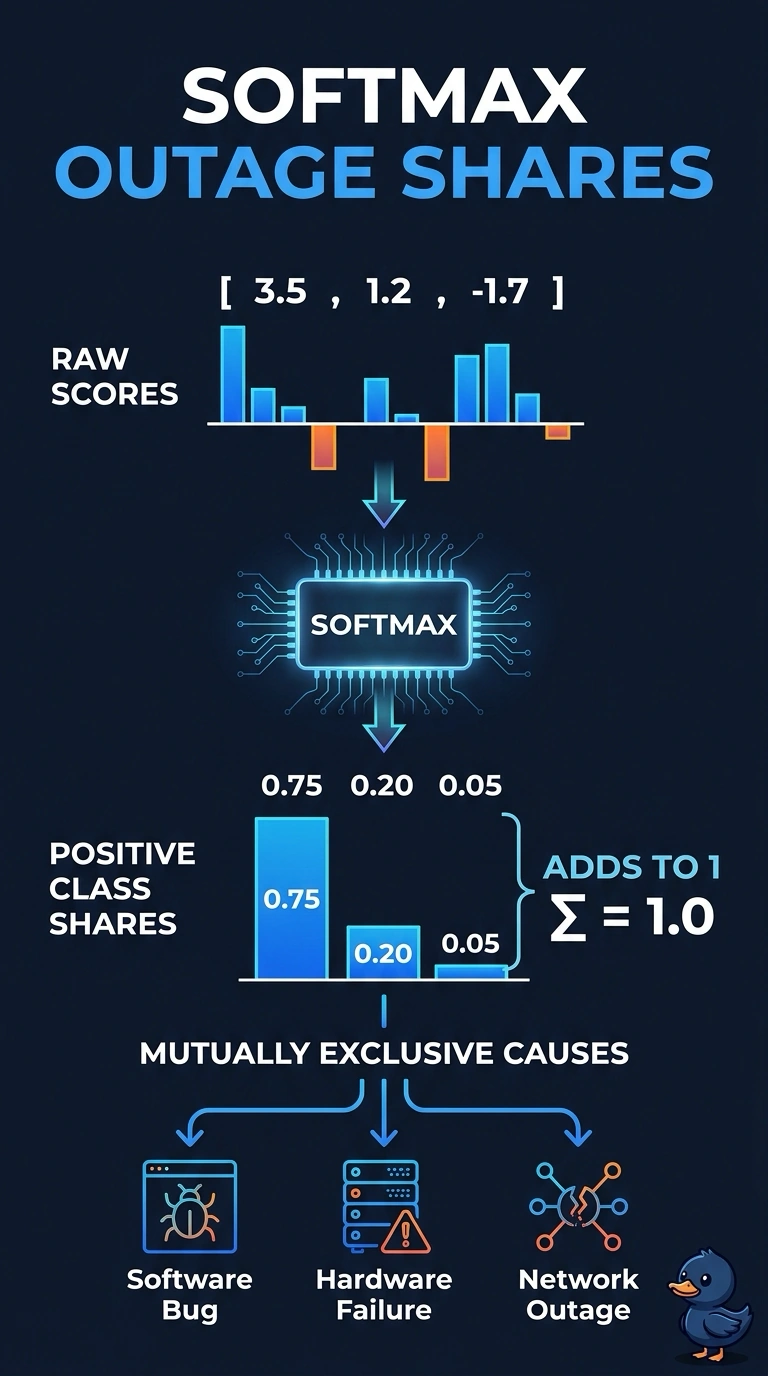
A utility classifier assigns each outage one of several mutually exclusive causes and must turn the raw scores into shares that add to one. Which output behavior does that?
Select an answer to reveal the explanation.
Short Explanation
You want the scores to behave like slices of one pie, every slice positive and the slices adding to the whole pie. Softmax does that for mutually exclusive outage causes. A separate squash on each score, or a single winner with no shares, does not.
Full Explanation
Softmax exponentiates each raw score and divides by the sum of those exponentials. Every output is positive, and the outputs add to one, so they read as class shares when exactly one outage cause is true. That is the map from an unbounded score vector to a single distribution. The shared denominator does the work: exponentiated scores are positive on their own, and dividing by their sum is what makes one outage's shares add to one. An independent sigmoid bounds each score separately and never divides by a shared total, so two causes can both sit high and the numbers need not add to one. A linear output keeps whatever real values the layer produced, with no positivity constraint and no requirement that they add to one. Argmax returns only the index of the largest score, which is a label rather than a full set of shares. Exam caveat: softmax fits mutually exclusive classes; if two causes can be true together, separate sigmoids match that multi-label case, but this stem requires shares that add to one. Operational check: on a batch of outage rows, confirm every output is positive and that each row sums to one aside from ordinary rounding.