
A logistics network with several layers scores delivery exceptions, and the team needs the loss to assign blame to an early weight by passing back through the later layers. Which procedure does that?
Select an answer to reveal the explanation.
Short Explanation
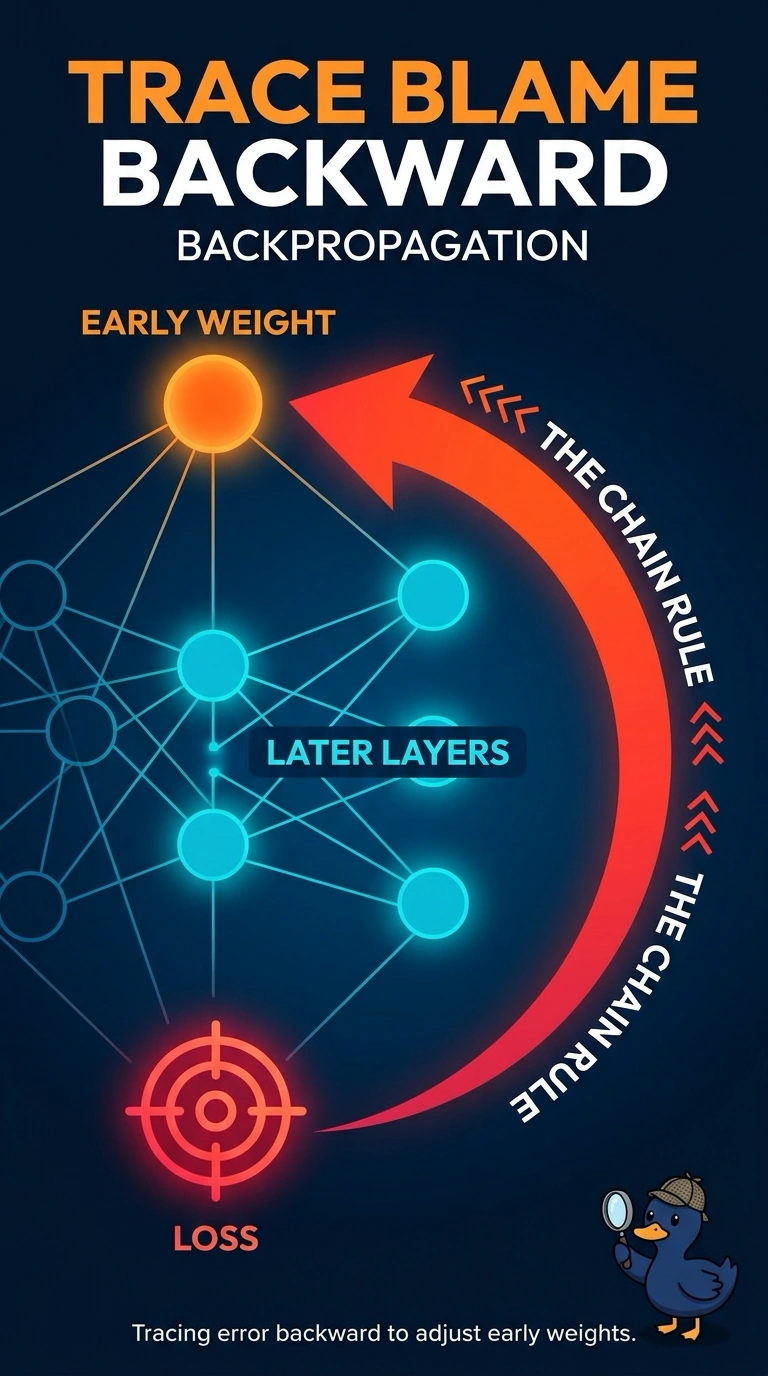
When a total is wrong you trace it back through each clerk who touched the ticket. Backpropagation applies the chain rule from the loss back through the later layers to the early weight. A forward scoring pass only runs the other direction.
Full Explanation
Backpropagation computes the gradient of the loss with respect to an early weight by the chain rule. The loss depends on the last layer, that layer depends on the one before it, and the product of those local derivatives carries blame back to the early weight. That is how a deep delivery-exception network tells an early weight whether to move. A forward pass applies the layers from inputs to prediction and does not propagate the loss backward. Dropout randomly zeros hidden units as a regularizer and does not compute a weight's gradient. Copying the scalar loss onto every early weight ignores the chain: two early weights that affect the loss differently would receive the same number, which is not a gradient. Exam caveat: the chain requires a path of local derivatives; a hard break in that path stops the blame from reaching the early weight. Operational check: compare the chain-rule gradient for one early weight with the change in loss from a tiny nudge of that weight on a single batch, and confirm the two agree in sign and scale.