
A logistics network's hidden activations change scale from one mini-batch of shipment scans to the next. The team wants each mini-batch recentered and rescaled from that batch's own mean and spread. Which method does that?
Select an answer to reveal the explanation.
Short Explanation
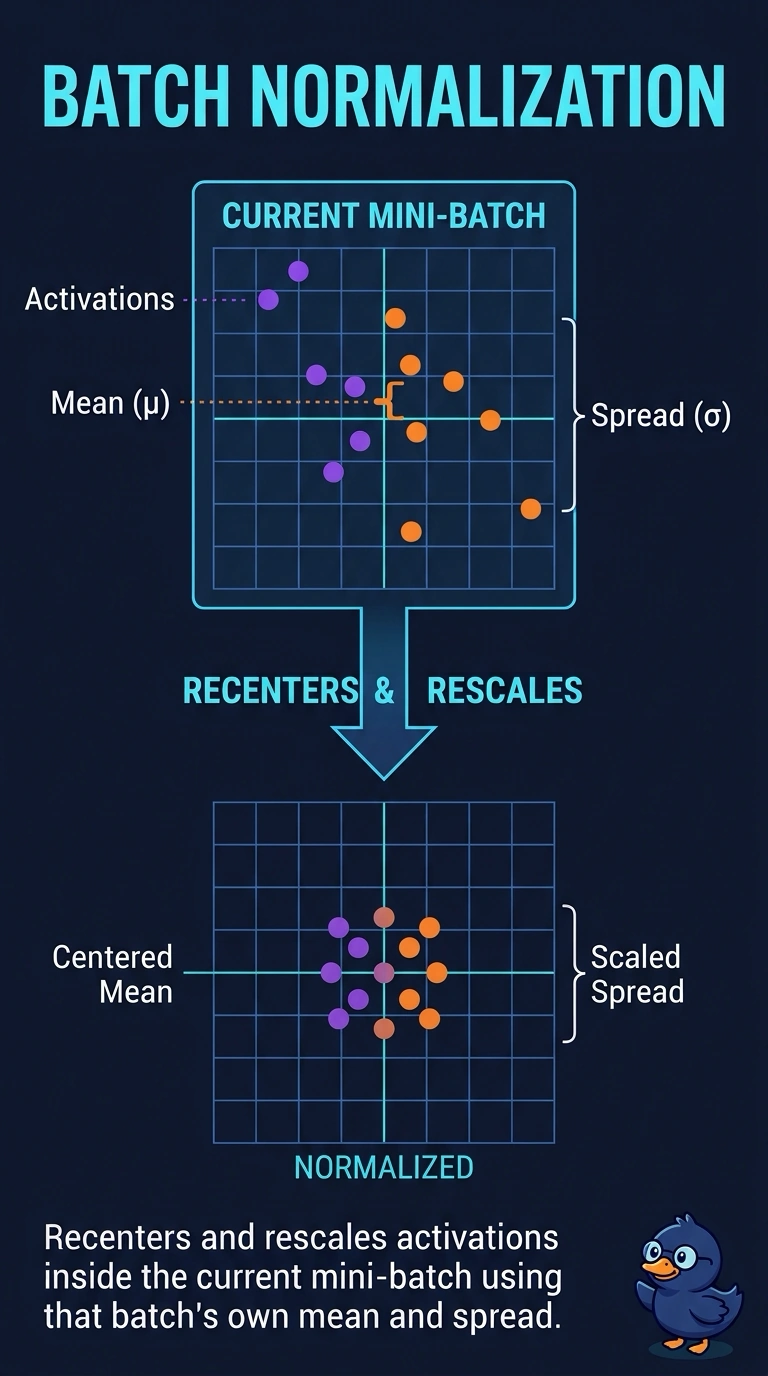
Each tray of parts should be set to a common scale before you compare trays. Batch normalization recenters and rescales activations inside the current mini-batch. A one-time rescaling of the raw file, or randomly benching units, answers a different problem.
Full Explanation
Batch normalization computes the mean and spread of a hidden activation inside the current mini-batch, subtracts that mean, and divides by that spread, then typically applies a learned scale and shift. Each shipment mini-batch is therefore put on a comparable scale using its own moments, which is the adjustment the logistics network needs. Dropout multiplies units by a random mask and does not estimate a batch mean or spread. A one-time standardization of the raw training file rescales inputs once, before the split, and does not recompute moments inside each mini-batch of hidden activations. Early stopping ends training when validation loss stalls and does not touch the scale of those activations. Exam caveat: the batch's own moments are a training behavior; at scoring time the usual practice is to use moments accumulated during training rather than the statistics of one live batch. Operational check: in a training step, confirm the layer's mean and spread are computed on the current mini-batch of activations, not on a single pass over the whole file.