
An apparel retailer's recommendation network memorizes training clicks. The team wants a regularizer that randomly turns some hidden units off on each training step. Which method is that?
Select an answer to reveal the explanation.
Short Explanation
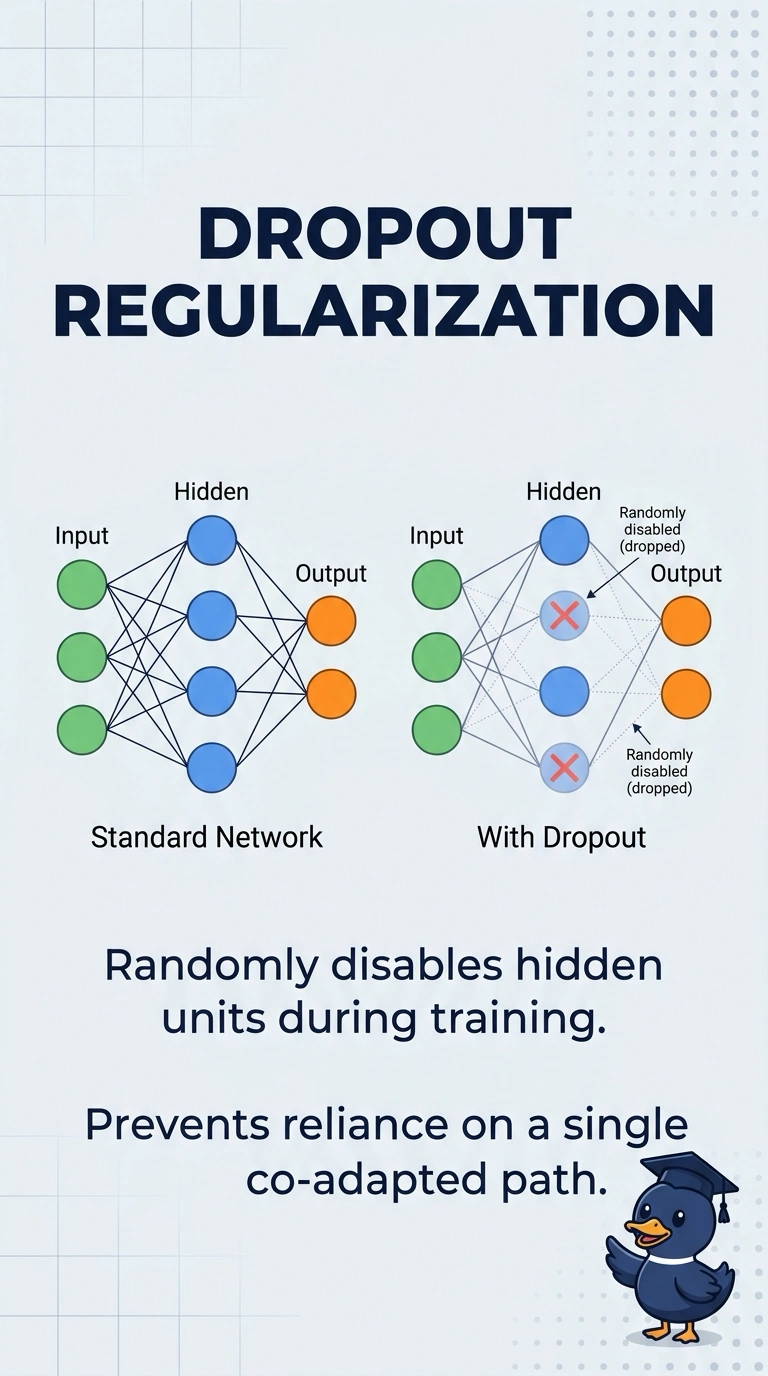
You can picture dropout as a scrimmage where you randomly bench a few players so the team cannot lean on one star. It randomly turns hidden units off during training, helping regularize the click model. Early stopping halts training, batch normalization rescales activations, and a larger epoch budget gives the network more passes; none randomly disables units.
Full Explanation
Dropout is a training regularizer that applies a random mask to hidden activations, setting some units to zero on each training step. Since a unit cannot rely on its neighbors always being present, the network is discouraged from using fragile co-adapted paths that memorize training clicks. The mask changes as training proceeds, so dropout is temporary randomness during learning, not a permanent change to the architecture. Early stopping monitors validation loss and ends training when it stalls; it does not disable units during a step. Batch normalization recenters and rescales activations within a mini-batch, but does not randomly turn units off. A larger epoch budget gives the network more passes over the same clicks and can increase memorization rather than regularize it. Exam caveat: random unit disabling is a training behavior; at scoring time, the full set of units is used, with scaling to keep expected activations consistent with training. Practical check: verify that the training loop applies a changing mask and that the scoring path uses the full network rather than one frozen mask.